
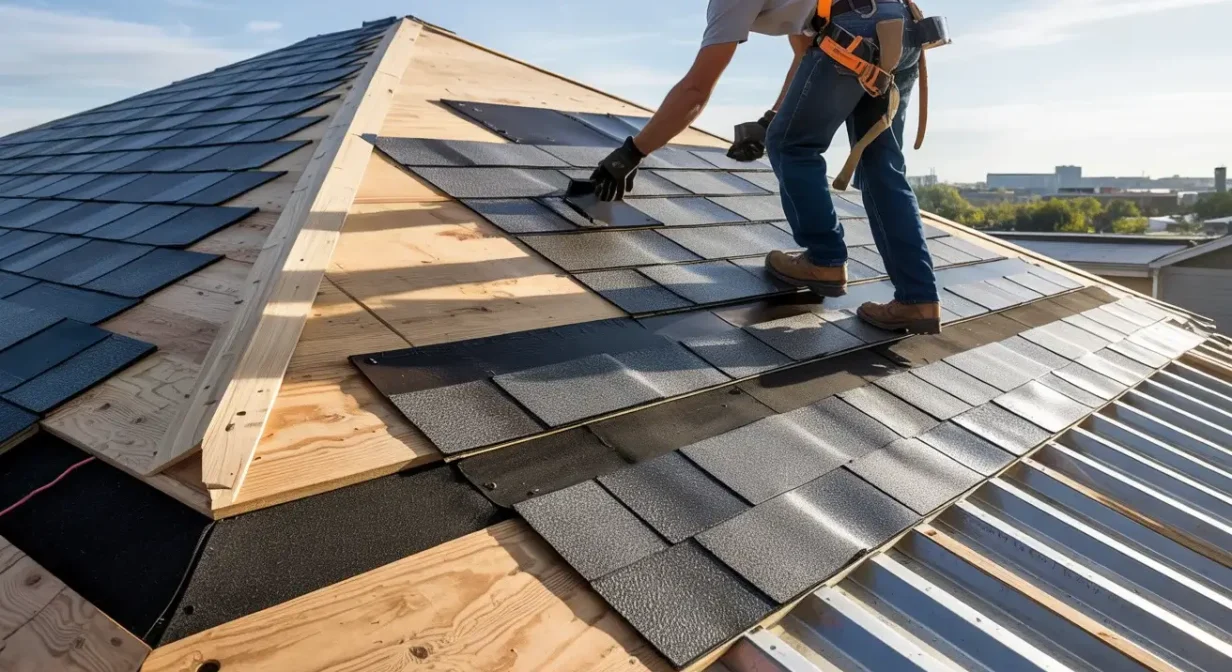
When you look at a roof from the outside, you see shingles, tiles, or metal panels. But beneath that visible layer lies the unsung hero of your roofing system: the roof decking. After eight years of installing and repairing roofs across Dallas’s residential and commercial properties, I’ve seen firsthand how quality roof decking makes the difference between a roof that lasts decades and one that fails prematurely.
At DeckingHub, we’ve worked on everything from historic homes in Oak Lawn to modern commercial buildings in the Dallas Arts District. Through hundreds of projects, one truth has become crystal clear: your roof is only as strong as the deck beneath it. Whether you’re a homeowner planning a roof replacement, a contractor looking to refine your knowledge, or a property manager evaluating your building’s needs, this comprehensive guide will give you the expertise to make informed decisions about roof decking.
The roof decking system forms the critical structural layer that ties your entire roofing assembly together. Without proper decking, even the most expensive shingles or premium metal roofing will fail prematurely.
What Is Roof Decking?
Roof decking, also called roof sheathing, is the structural foundation of your roofing system. It’s the solid surface that sits directly on top of your roof’s framing members (rafters or trusses) and provides the base for everything else: underlayment, roof flashing, and your final roofing material.
Think of roof decking as the foundation of a house, but for your roof. Just as you wouldn’t build a home on a weak foundation, you shouldn’t install roofing materials on compromised decking. The deck serves several critical functions that directly impact your home’s safety, energy efficiency, and longevity.
The Critical Role of Roof Decking
Structural Support: Roof decking distributes the weight of your roofing materials, snow loads, and even foot traffic during maintenance across your home’s structural framework. In Dallas, while we don’t deal with heavy snow, we regularly encounter severe storms with high winds and occasional hail. Quality decking ensures your roof can withstand these forces.
Attachment Point: Your roofing materials need something solid to attach to. Whether you’re installing architectural roof shingles, metal roofing, or a residential flat roof system, the decking provides the critical surface for fasteners to grip. Poor or deteriorated decking leads to loose shingles, leaks, and premature failure.
Barrier Against Elements: While not waterproof on its own, roof decking works with roof deck protection systems to create your first line of defense against moisture infiltration. It bridges the gaps between rafters, preventing wind-driven rain from entering your attic.
Fire Resistance: Modern roof decking materials provide a level of fire resistance that helps slow the spread of flames. This becomes particularly important in areas prone to wildfires or in commercial buildings where fire codes are stringent.
How Roof Decking Differs from Other Components
Many homeowners confuse roof decking with other roofing elements. Understanding what is roof deck attachment helps clarify these distinctions. The decking is specifically the sheathing layer, while components like roof underlayment, drip edge, and roofing materials are separate layers built on top of it.
The proper sequence from bottom to top is: rafters/trusses → roof decking → underlayment → roofing material. Each layer depends on the integrity of the one beneath it.
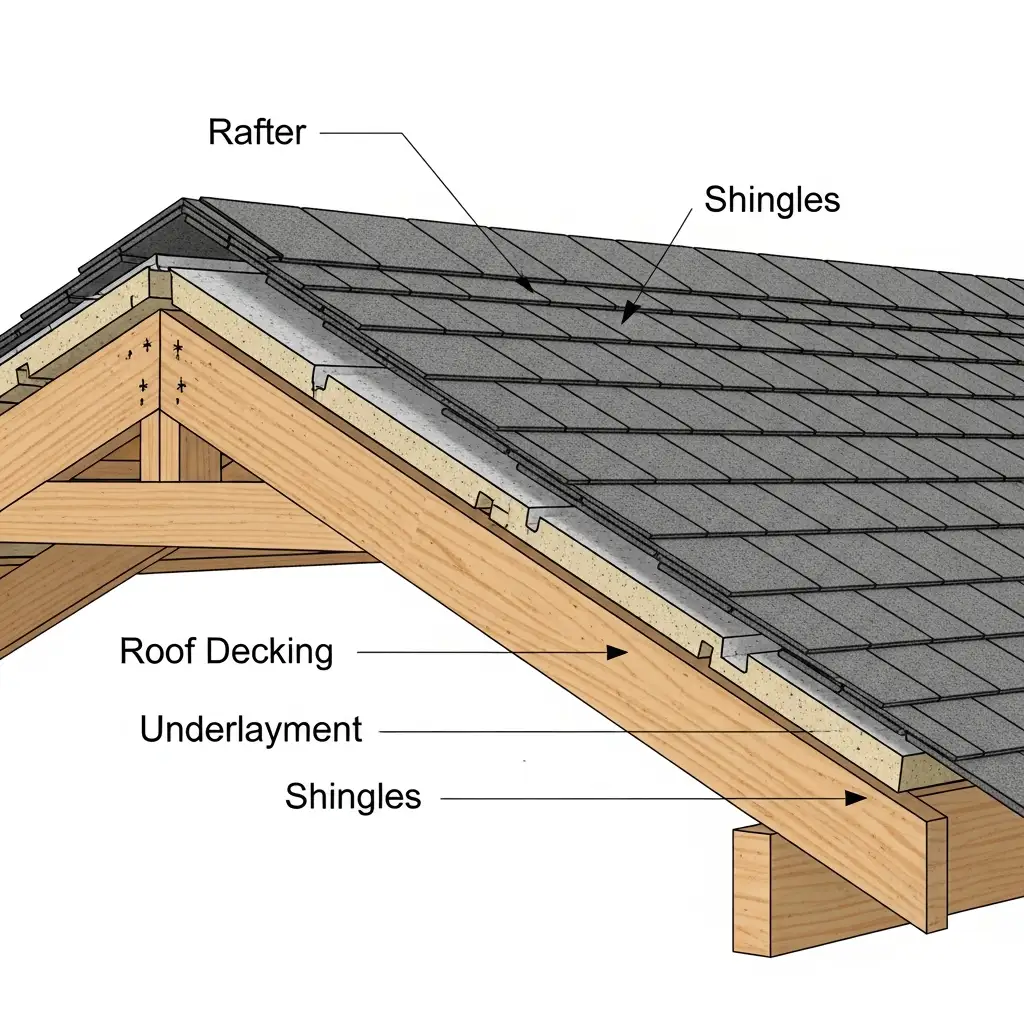
Roof decking provides the crucial foundation for your roofing system. Ensure proper installation for a durable and long-lasting roof. Learn more about roof decking best practices!
Types of Roof Decking Materials
Choosing the right decking material impacts everything from installation costs to long-term performance. Over my years installing roofs in Dallas’s variable climate—where summer temperatures regularly exceed 100°F and winter storms can bring ice and high winds—I’ve worked with virtually every decking type available. Here’s what you need to know about each option.
Wood-Based Decking
Wood-based products dominate the residential roofing market, and for good reason. They offer an excellent balance of strength, workability, and cost-effectiveness.
Plywood Roof Decking
Plywood remains the gold standard for residential roof decking. Made from thin layers (plies) of wood veneer glued together with the grain of each layer running perpendicular to adjacent layers, plywood creates exceptional dimensional stability and strength.
Advantages of Plywood:
- Superior strength-to-weight ratio compared to solid wood
- Excellent resistance to splitting when fasteners are driven near edges
- Better moisture resistance than OSB
- Maintains structural integrity even when partially wet
- Easier to work with during installation
- Better performance in humid climates like Dallas
Common Plywood Grades: For roofing applications, we typically use CDX plywood (C-grade face, D-grade back, exterior glue) or better. The “X” designation indicates exterior-grade adhesive that can withstand moisture exposure. For premium installations, we sometimes use tongue-and-groove plywood that creates tighter joints between panels.
Thickness Considerations: Standard thicknesses are 15/32″, 1/2″, 5/8″, and 3/4″. The required thickness depends on your rafter spacing, which we’ll cover in detail when discussing how thick should roof decking be.
In Dallas, where summer heat can be brutal, plywood’s ability to resist warping under extreme temperature fluctuations makes it particularly valuable. We’ve seen OSB panels buckle during intense heat waves, while properly installed plywood maintains its form.
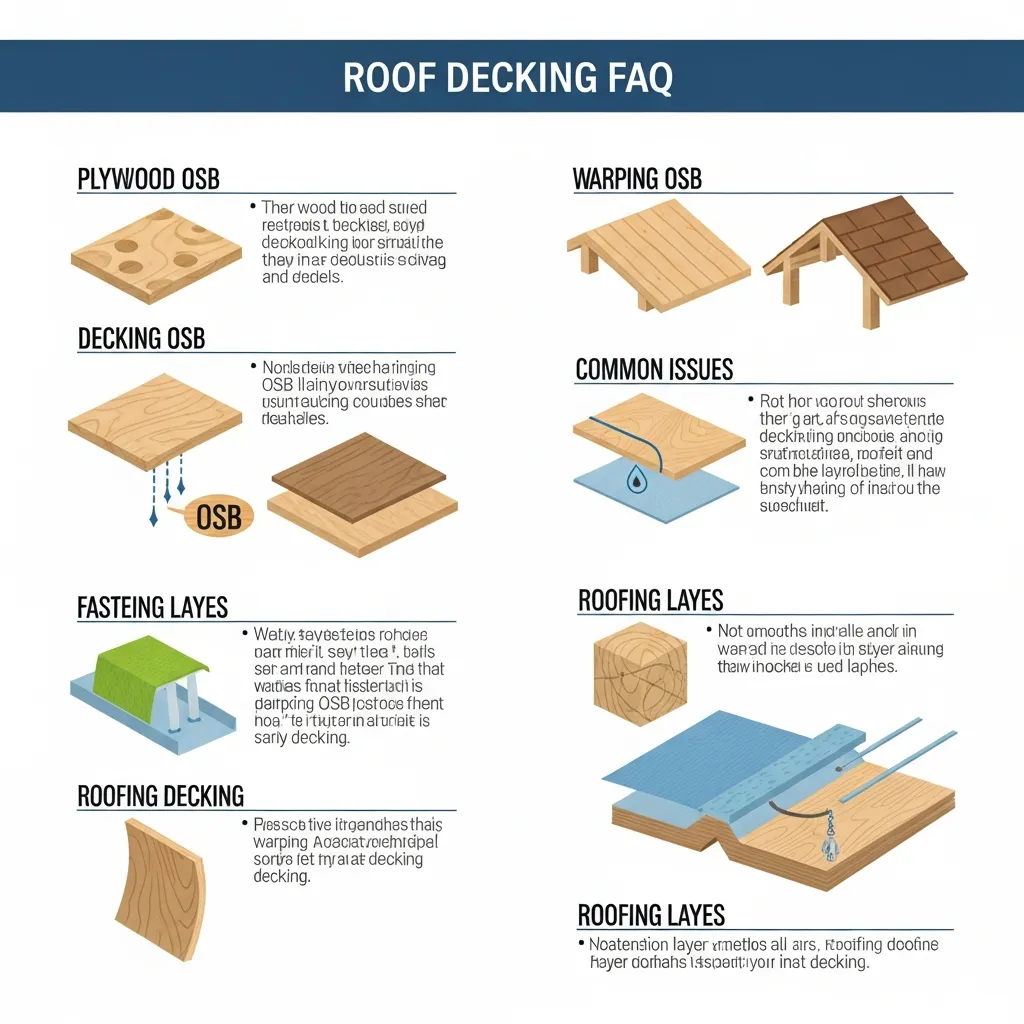
OSB (Oriented Strand Board)
OSB has gained significant market share over the past two decades, particularly in new construction where cost considerations drive material selection. Made from compressed wood strands bonded with adhesives, OSB offers a more affordable alternative to plywood.
How OSB Is Made: Manufacturers compress layers of wood strands (typically aspen, southern pine, or other fast-growing species) with waterproof adhesives under high heat and pressure. The strands in each layer are oriented perpendicular to adjacent layers, similar to plywood’s construction.
OSB Strengths:
- Lower cost than comparable plywood (typically 15-25% less expensive)
- Consistent quality with fewer defects than plywood
- More uniform thickness across panels
- Excellent fastener-holding capability
- Environmentally friendly use of smaller, faster-growing trees
OSB Weaknesses:
- Swells significantly when exposed to moisture
- Takes longer to dry once wet compared to plywood
- More susceptible to edge swelling along panel edges
- Can delaminate if water intrusion occurs
- Less forgiving during installation in humid conditions
From our Dallas projects, I’ve learned that OSB requires extra care during installation. If rain is forecast within 24-48 hours, we either delay installation or ensure we can cover the entire roof section before the storm arrives. Once OSB swells from moisture exposure, it rarely returns to its original dimensions, which can create issues with shingle installation and roof ventilation components.
Tongue and Groove Planks
Before plywood and OSB became standard, solid wood planks were the norm. While less common in new construction, we still encounter roof planks regularly when working on historic Dallas homes, particularly in neighborhoods like Munger Place or Swiss Avenue.
Characteristics of Plank Decking:
- Individual boards (typically 1×6 or 1×8) laid perpendicular to rafters
- Tongue-and-groove edges create tighter joints
- Common in homes built before 1950
- Often made from pine, fir, or cedar
- Can last 80-100+ years when properly maintained
When We Recommend Planks: For historic renovation projects where maintaining authenticity matters, or when only partial deck replacement is needed on a home with existing plank decking. Matching existing materials ensures proper load distribution and maintains the home’s character.
Plank Deck Challenges: Gaps between planks can widen over time as wood shrinks. This requires specialized underlayment approaches. We typically use peel and stick roof underlayment over plank decks to create a continuous waterproof barrier that compensates for gaps between boards.
Metal Roof Decking
While wood products dominate residential applications, metal decking is the standard for commercial and industrial buildings. In Dallas’s commercial district, virtually every office building, warehouse, and retail center uses some form of metal decking.
Corrugated Steel Decking
Corrugated steel decking and corrugated decking systems offer unmatched strength for long spans between structural supports. The corrugated (wavy) profile creates structural ridges that dramatically increase the panel’s load-bearing capacity.
Metal Decking Applications:
- Commercial buildings with long rafter spans
- Industrial facilities requiring high load capacity
- Buildings requiring Class A fire rating
- Structures where deck serves as permanent ceiling
- Parking garages and mechanical equipment platforms
Steel Deck Gauges: Metal decking thickness is measured in gauge—the higher the gauge number, the thinner the metal. Common gauges for roof decking include:
- 22-gauge: Light-duty applications, short spans
- 20-gauge: Standard commercial applications
- 18-gauge: Heavy-duty applications
- 16-gauge: Extra-heavy applications, long spans
Profile Depths: Steel decking comes in various depths (typically 1.5″, 2″, 3″, or deeper), with deeper profiles spanning longer distances between supports.
In my experience with Dallas commercial projects, steel decking’s fire resistance and durability make it ideal for buildings with strict fire codes or those requiring rooftop HVAC equipment access. The Metal Roof Decking we install on commercial projects routinely supports not just the roofing system but also regular foot traffic from maintenance personnel.
Corrugated Concrete Decking
For ultimate durability and fire resistance, corrugated concrete decking tops the list. While less common than steel, concrete decking appears in high-rise construction and buildings requiring maximum fire protection.
Concrete Deck Benefits:
- Exceptional fire resistance (Class A rating)
- Superior sound dampening properties
- Excellent thermal mass for energy efficiency
- Virtually maintenance-free once installed
- Resistant to rot, insects, and environmental degradation
Concrete Deck Limitations:
- Significantly heavier than alternatives (requires stronger structural support)
- More expensive than wood or steel options
- Requires specialized installation equipment
- Limited to new construction (impractical for retrofits)
Specialty Decking Solutions
Innovation in roofing materials continues to produce specialized decking products designed to address specific performance needs.
Radiant Barrier Roof Decking
Texas summers are brutal. When your attic can reach 150°F on a July afternoon, every bit of heat reflection helps. Radiant barrier roof decking features a reflective foil layer laminated to standard OSB or plywood, reflecting up to 97% of radiant heat away from your attic space.
How Radiant Barriers Work: The reflective surface faces the attic space, creating an air gap between the hot roof deck and the attic insulation. Rather than absorbing heat and conducting it into your attic, the radiant barrier reflects it back toward the roof surface.
Energy Savings: In Dallas’s climate, radiant barrier decking can reduce attic temperatures by 20-30°F and cooling costs by 5-10%. While the upfront cost runs about 10-15% higher than standard decking, the energy savings typically recover this investment within 3-5 years.
Installation Considerations: The radiant barrier must face an air space to function effectively. Installing it upside-down or covering the reflective surface with insulation eliminates the benefit. When we install radiant barrier decking, proper attic ventilation becomes even more critical to manage the increased heat at the roof surface.
Insulated Decking Systems
Some manufacturers offer composite decking products with integrated foam insulation. These products combine structural support with thermal resistance in a single layer, though they’re more common in commercial applications than residential projects.
Fire-Rated Decking
In wildfire-prone areas or where building codes require enhanced fire protection, fire-rated decking products offer additional safety. These typically feature fire-retardant treatment or incorporate non-combustible materials into the panel construction.
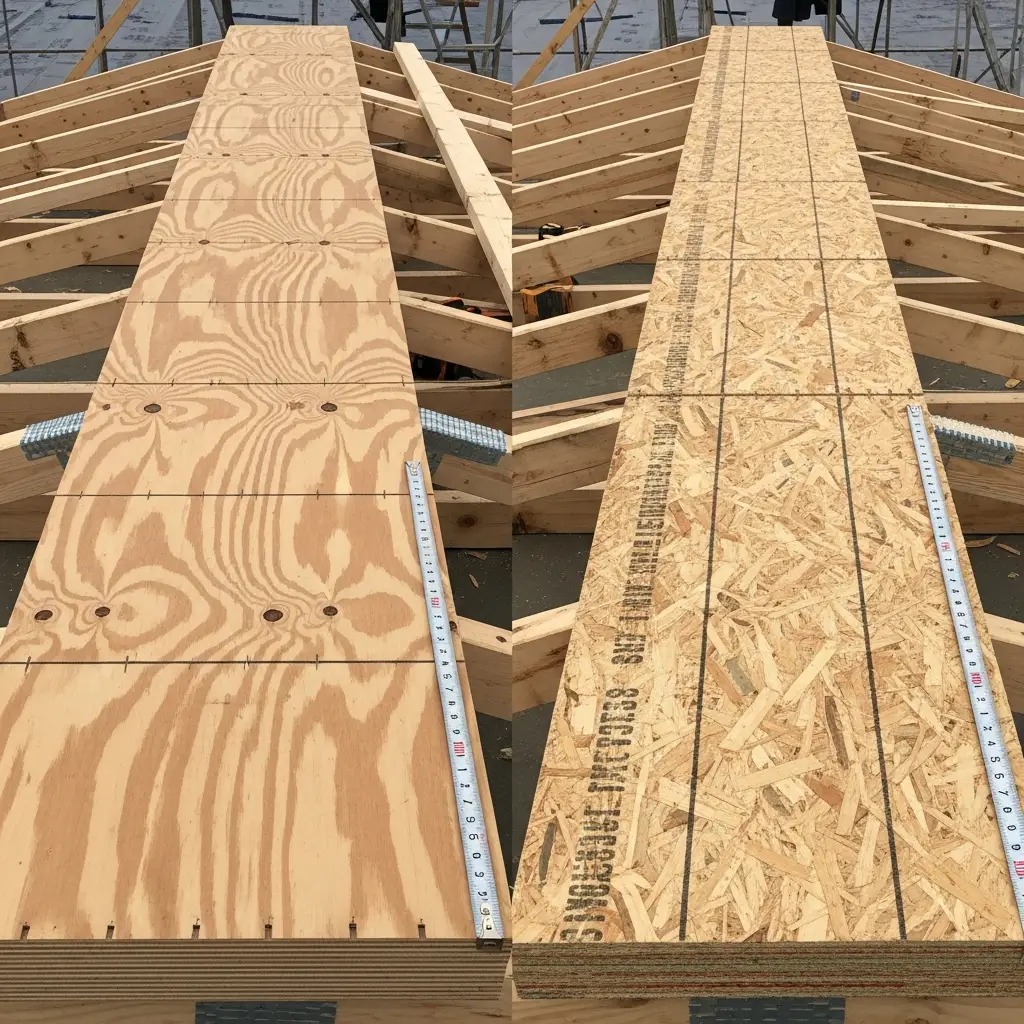
Types of Roof Decking Materials
Roof Decking Thickness and Building Codes
One of the most common questions I hear from homeowners is: “How thick does my roof decking need to be?” The answer depends on several factors, but building codes provide clear minimum standards designed to ensure structural safety.
Code Requirements and Standards
Roof decking requirements are primarily governed by the International Residential Code (IRC) for residential buildings and the International Building Code (IBC) for commercial structures. These codes establish minimum standards, though local jurisdictions may impose stricter requirements.
The IRC specifies minimum thickness based on three key factors:
- Rafter spacing (distance between supports)
- Expected roof loads (dead load plus live load)
- Decking material type
Standard Rafter Spacing: Most residential construction uses rafters spaced at 16″ or 24″ on center (measured from the center of one rafter to the center of the next). Commercial buildings may have wider spacing, requiring thicker or stronger decking.
Thickness Requirements by Rafter Spacing
For the most common residential scenarios using plywood or OSB:
16″ Rafter Spacing:
- Minimum thickness: 15/32″ (commonly rounded to 1/2″)
- Recommended: 1/2″ for standard residential loads
- Heavy snow areas: 5/8″ or greater
24″ Rafter Spacing:
- Minimum thickness: 1/2″
- Recommended: 5/8″ for most applications
- Heavy loads: 3/4″
In Dallas, where snow loads are minimal, we typically use 1/2″ decking for 16″ spacing and 5/8″ for 24″ spacing. This provides adequate strength with some safety margin. However, understanding how thick should roof decking be for your specific situation requires considering additional factors.
Load Calculations
Building codes require roof decking to support both dead loads (permanent weight of materials) and live loads (temporary loads like maintenance workers, equipment, or in some regions, snow).
Typical Residential Loads:
- Dead load: 10-15 pounds per square foot (psf)
- Live load: 20-30 psf (varies by region)
- Total design load: 30-45 psf minimum
For slate roofing, which weighs 800-1,500 pounds per roofing square, thicker decking and closer rafter spacing become necessary. We’ve worked on historic Dallas homes with slate roofs where the original builders wisely used 3/4″ plank decking over 12″ rafter spacing.
Regional Code Variations
While the IRC and IBC provide national standards, local jurisdictions often modify requirements based on regional conditions. In Texas, our primary concerns are wind resistance and occasional ice loads rather than heavy snow.
Dallas-Specific Considerations:
- Wind Zone 2 (120 mph design winds for most areas)
- Minimal snow load (typically 5-10 psf)
- High heat and UV exposure
- Occasional severe ice storms
These factors influence both material selection and fastening patterns. Wind uplift during severe thunderstorms is a real concern, which is why proper roof deck attachment is critical in our area.
Obtaining Permits and Code Compliance
Any roof replacement project involving structural work requires permits and inspections. Understanding roof deck codes and permits helps avoid costly mistakes and ensures your roof meets legal requirements.
When we work on projects in Dallas, we coordinate with city building departments to ensure compliance with:
- Minimum thickness requirements
- Fastening schedules
- Fire resistance ratings
- Energy code compliance (particularly for new construction)
- Historic district requirements (for designated neighborhoods)
Pro Tip: Before starting any significant roofing project, consult with your local building department. Requirements can vary significantly between neighboring jurisdictions. What’s acceptable in Dallas may differ from requirements in nearby Plano or Fort Worth.
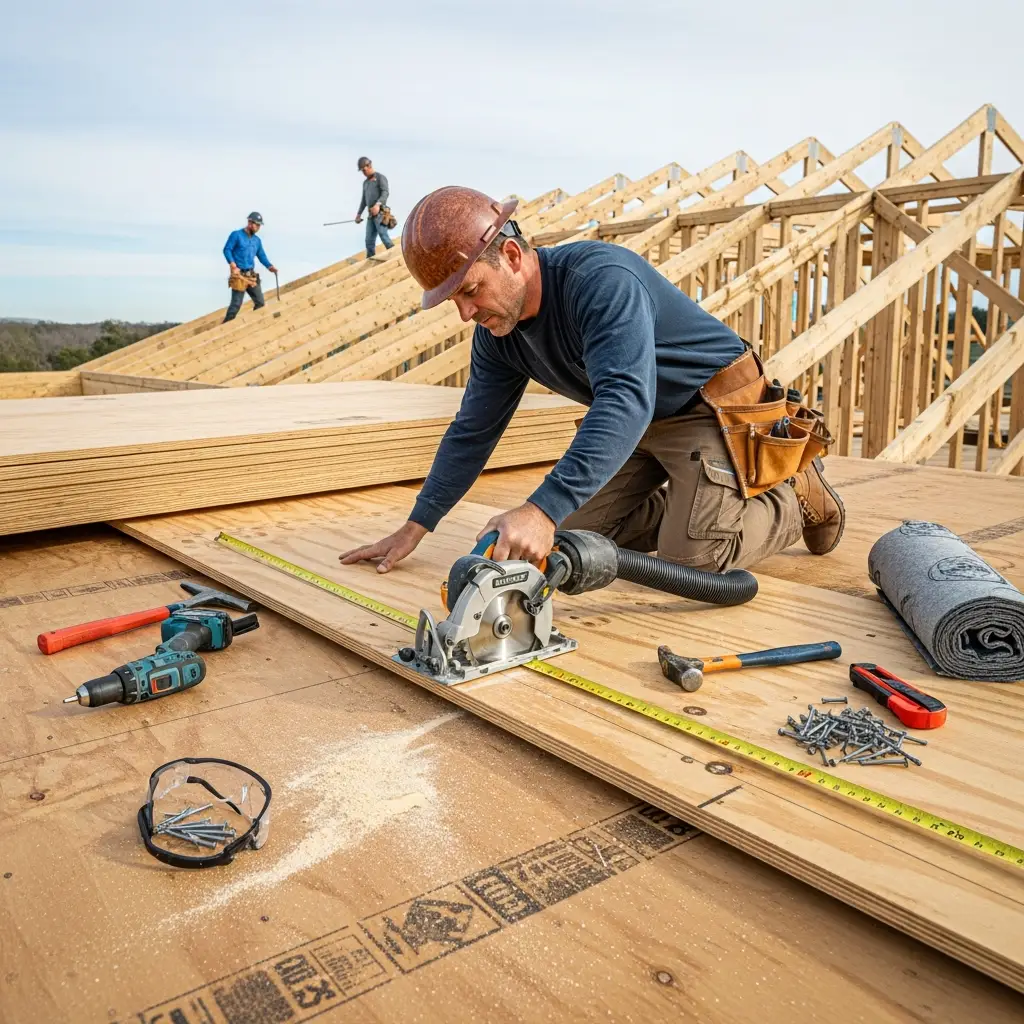
Ensuring proper roof decking thickness is crucial for meeting building codes and ensuring structural integrity. Learn the factors that impact thickness requirements!
Roof Decking Installation Best Practices
Proper installation makes the difference between a roof deck that performs flawlessly for decades and one that fails prematurely. After hundreds of installations across Dallas, I’ve learned that attention to detail during decking installation prevents countless problems down the road.
Preparation and Planning
Structural Inspection: Before installing new decking, we thoroughly inspect the rafter or truss system. Look for:
- Sagging or damaged rafters
- Proper rafter spacing and alignment
- Adequate ventilation paths
- Signs of previous water damage or rot
- Proper support at eaves, valleys, and ridges
Addressing structural issues before decking installation saves massive headaches later. I’ve seen contractors install beautiful new decking over sagging rafters, only to have the entire roof show wave patterns visible from the street.
Material Acclimation: Wood-based decking should acclimate to local humidity conditions before installation. In Dallas’s variable climate, we store materials on-site for 24-48 hours when possible. This reduces warping and expansion issues after installation.
Layout Planning: Proper panel layout minimizes waste and ensures structural integrity. Key principles:
- Stagger end joints (don’t line up joints across multiple rows)
- Center panel edges on rafters when possible
- Plan for proper expansion gaps
- Account for valleys, hips, and other transitions
- Ensure adequate edge support at all panel perimeters
Critical Installation Techniques
Expansion Gaps: Wood expands and contracts with moisture and temperature changes. Inadequate gaps between panels can cause buckling, particularly with OSB. Standard gaps:
- Panel edges: 1/8″ minimum
- End joints: 1/8″ to 1/4″
- Humid climates or OSB: increase to 1/4″
In Dallas summers, I’ve seen improperly gapped OSB panels buckle so severely they pushed shingles up, creating visible ridges. A simple 1/8″ gap prevents this entirely.
H-Clips for Panel Support: When rafters are spaced 24″ on center, H-clips (small metal clips) installed between panel edges provide additional support and maintain proper spacing. These clips fit into the panel edges and create consistent gaps while preventing differential movement between adjacent panels.
Fastening Patterns: Proper fastening is governed by roof deck attachment requirements. For most residential applications:
- Fastener type: 8d common nails (2-1/2″ x 0.131″) or equivalent screws
- Panel perimeter: 6″ on center
- Field (interior): 12″ on center
- High-wind zones: may require 4-6″ on center at perimeter
Fastening Best Practices:
- Drive fasteners flush with surface (not overdriven)
- Maintain 3/8″ minimum edge distance from panel edges
- Use ring-shank or screw-shank nails for superior holding power
- In wind-prone areas, use screws for maximum uplift resistance
I always use screws rather than nails for deck installation in Dallas. The upfront cost is slightly higher, but the superior holding power provides peace of mind during severe thunderstorms. We’ve never had a screw-fastened deck fail during wind events that tore nailed decking from neighboring properties.
Roof Penetrations and Openings: Areas around roof penetrations like plumbing vents, chimneys, and skylights require special attention. We:
- Frame openings with doubled rafters or blocking
- Install decking tight to penetration flanges
- Use metal drip edge or specialty flashings at transitions
- Ensure solid backing for all roof flashing components
Valley and Hip Treatment: Roof valleys concentrate water flow, requiring extra protection. We install decking continuously through valleys, then add valley metal or specialty underlayment. For hips and roof ridges, ensuring solid backing for ridge vents is critical for proper roof ventilation.
Common Installation Mistakes to Avoid
Through years of correcting others’ work, I’ve seen these errors repeatedly:
Insufficient Edge Support: Panel edges must bear on rafters or blocking. Unsupported edges create bounce, telegraphing through shingles and creating premature wear.
Incorrect Fastener Placement: Fasteners too close to panel edges can cause splitting. Too far from edges allows panels to lift. Following manufacturer specifications prevents both issues.
Inadequate Nailing: Skipping fasteners to save time creates weak spots. In storm damage roof replacement projects, we consistently find that deck sections with insufficient fastening fail first.
Installing Wet Materials: Never install wet OSB or plywood. Once installed and covered, moisture becomes trapped, leading to delamination, mold growth, and structural degradation. If materials get wet during installation, allow them to dry completely before covering, or replace them.
Ignoring Manufacturer Instructions: Different products have different requirements. Always check manufacturer specifications for the specific product you’re installing.
Weather Considerations
Dallas weather can be unpredictable. Here’s how we handle various conditions:
Hot Weather: Summer temperatures exceeding 100°F make installation physically demanding but don’t significantly impact material performance. We start early, take frequent breaks, and stay hydrated.
Cold Weather: Roofing in the winter presents different challenges. While Dallas winters are mild compared to northern climates, we occasionally face freezing conditions. Fasteners can become brittle, and handling materials requires care to prevent cracking.
Wet Conditions: We never install decking during rain or when rain is imminent. If we can’t cover a deck section completely before weather arrives, we don’t start it. The exception: we’ll install during overcast conditions if we can complete the section and apply underlayment before rain begins.
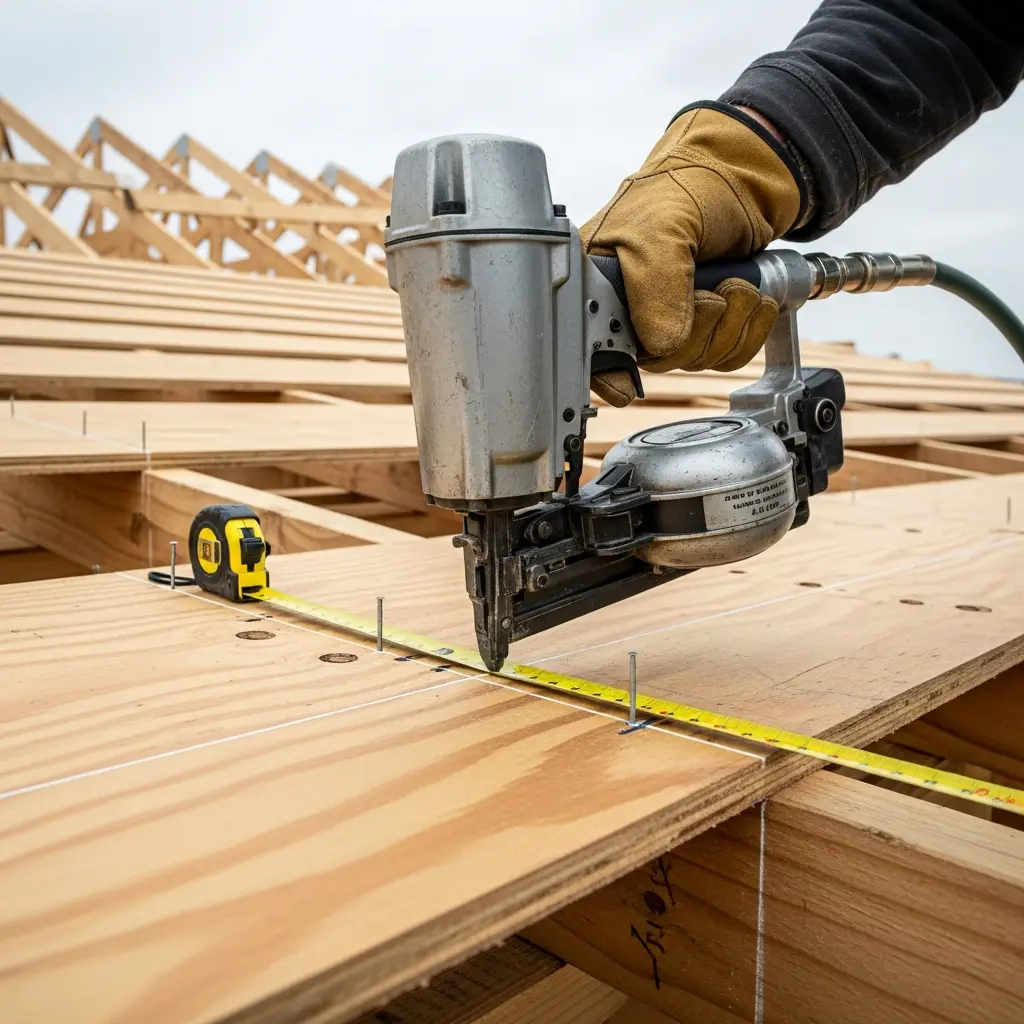
Proper expansion gaps and fastening are crucial! Small details like H-clips can dramatically increase your roof deck’s lifespan and prevent future issues. Call us for expert roof decking installation.
Roof Decking Replacement: When and Why
Understanding when to replace roof decking can save thousands of dollars in water damage and prevent structural failures. Not every roof replacement requires new decking, but knowing the warning signs helps you make informed decisions.
Signs Your Roof Decking Needs Replacement
Visible Sagging: Stand back and look at your roof’s profile. The surface should follow straight lines from ridge to eave and from end to end. Sagging areas indicate structural problems—either damaged rafters or deteriorated decking.
From street level, sagging might appear subtle, but it signals serious issues. What looks like a slight dip often represents significant structural damage hidden beneath the roofing materials.
Water Stains on Ceilings: Those brown circles or streaks on your ceiling indicate water penetration. While the leak might originate at a roof penetration or damaged shingle, prolonged exposure rots the decking. Learning how to remove water stains from ceiling addresses the cosmetic issue, but the underlying deck damage requires professional assessment.
Attic Inspection Findings: The best way to assess deck condition is from below. In your attic, look for:
- Light penetrating through deck boards (indicates gaps or holes)
- Dark staining on decking (water damage)
- Soft or spongy areas when pressed
- Visible mold or mildew growth
- Delamination (layers separating in plywood/OSB)
- Sagging between rafters
Age-Related Deterioration: Even without obvious damage, decking eventually reaches the end of its service life. Understanding roof age helps determine whether replacement makes economic sense. If your roof is 25+ years old and you’re replacing the shingles, the marginal cost of deck replacement might be justified even if current decking appears serviceable.
Storm Damage Indicators: After severe weather, specific signs indicate deck damage:
- Missing shingles in multiple areas
- Dents or punctures in decking (visible from attic)
- Cracked or split panels
- Fastener pull-through (fasteners pulled through deck material)
When assessing wind damage roof or storm damage roof replacement needs, we examine both the roofing materials and underlying deck. Insurance companies often cover deck replacement when storm damage is properly documented.
Common Causes of Deck Deterioration
Roof Leaks: The primary enemy of roof decking is water. Even minor leaks cause progressive damage. A small roof leak repair addressed quickly prevents deck damage, while ignored leaks inevitably lead to extensive deterioration.
Common leak sources that damage decking:
- Failed roof vent pipe boot assemblies
- Damaged or missing roof flashing
- Ice dams (less common in Dallas but possible during rare ice storms)
- Roof vent leaks from improperly installed or damaged vents
- Wind-driven rain through damaged shingles
Condensation Issues: Roof condensation occurs when warm, moist air from living spaces contacts cold decking. This is particularly problematic in improperly ventilated attics. The resulting moisture accumulation rots decking from below, often going unnoticed until significant damage occurs.
Proper roof ventilation prevents condensation by maintaining consistent attic temperature and allowing moisture to escape. Installing adequate roof vents costs far less than replacing moisture-damaged decking.
Poor Installation: Decking installed without proper expansion gaps, insufficient fastening, or over wet lumber fails prematurely. We regularly encounter granular loss roof issues where buckling decking has abraded shingles from below.
Inadequate Protection: Decking relies on overlying systems for protection. Failed or absent underlayment allows water to contact decking directly. The best roof underlayment creates a secondary barrier that protects decking even if primary roofing fails.
The Deck Replacement Process
Understanding what’s involved in deck replacement helps set realistic expectations and budget appropriately.
Step 1: Comprehensive Inspection
Professional roof inspection identifies the extent of damage. Many homeowners ask how long does a roof inspection take—typically 45-90 minutes for a thorough assessment including attic inspection and roof surface evaluation.
During inspection, we:
- Document all damage with photos
- Mark affected areas for replacement
- Assess rafter condition
- Check ventilation adequacy
- Identify contributing factors (poor drainage, inadequate ventilation, etc.)
Step 2: Material Selection
Based on your budget, local code requirements, and performance needs, we recommend appropriate decking materials. For most Dallas residential projects, we suggest either 1/2″ or 5/8″ plywood or OSB, occasionally upgrading to radiant barrier decking for enhanced energy efficiency.
Step 3: Removal of Old Materials
Proper removal prevents damage to underlying structure:
- Strip existing roofing materials carefully
- Remove damaged decking sections
- Inspect and repair rafter damage
- Clean work area of all debris
- Protect vulnerable areas from weather exposure
Step 4: New Deck Installation
Following best practices detailed earlier:
- Install new decking with proper spacing and fastening
- Ensure adequate edge support
- Install required blocking or H-clips
- Flash all penetrations properly
- Prepare surface for underlayment
Step 5: Complete Roofing System
With quality decking in place, we install:
- Appropriate underlayment (peel and stick roof underlayment at vulnerable areas)
- Drip edge on roof perimeters
- Proper roof flashing systems
- Final roofing material
- Roof ventilation components
Timeline Expectations: Complete deck replacement and re-roofing typically takes 2-5 days for average residential homes, depending on size, complexity, and weather. Understanding what does roof replacement include helps you evaluate contractor proposals and ensure nothing gets overlooked.
Cost Factors and Budgeting
The question of cost to replace roof decking varies significantly based on multiple factors:
Material Costs:
- OSB: $15-25 per sheet
- Plywood: $25-45 per sheet
- Radiant barrier: $30-55 per sheet
- Metal decking: $3-8 per square foot
Labor Costs: In Dallas, labor for deck replacement typically runs $2-4 per square foot, varying with:
- Roof pitch (steeper roofs cost more)
- Access difficulty
- Extent of damage
- Disposal requirements
Total Project Costs: For a typical 2,000 square foot roof requiring 50% deck replacement:
- Materials: $800-1,500
- Labor: $2,000-4,000
- Disposal: $300-600
- Total: $3,100-6,100
Full replacement (all decking):
- Materials: $1,600-3,000
- Labor: $4,000-8,000
- Disposal: $600-1,200
- Total: $6,200-12,200
Financing and Insurance Considerations
Roof replacement represents a significant investment. Exploring options to finance a new roof makes this essential maintenance more manageable. Common financing approaches include:
- Home equity loans or lines of credit
- Personal loans
- Contractor financing programs
- Credit cards (for smaller projects)
- FHA 203(k) renovation loans
For storm-damaged roofs, understanding how to get insurance to pay for roof replacement can save thousands. Key steps:
- Document all damage immediately with photos
- File insurance claim promptly
- Obtain professional inspection report
- Provide detailed repair estimates
- Negotiate with adjusters (most initial offers are negotiable)
- Understand your policy’s coverage limits and deductibles
In Dallas, we regularly work with insurance companies after hail storms and wind events. Proper documentation and professional advocacy significantly improve claim outcomes.
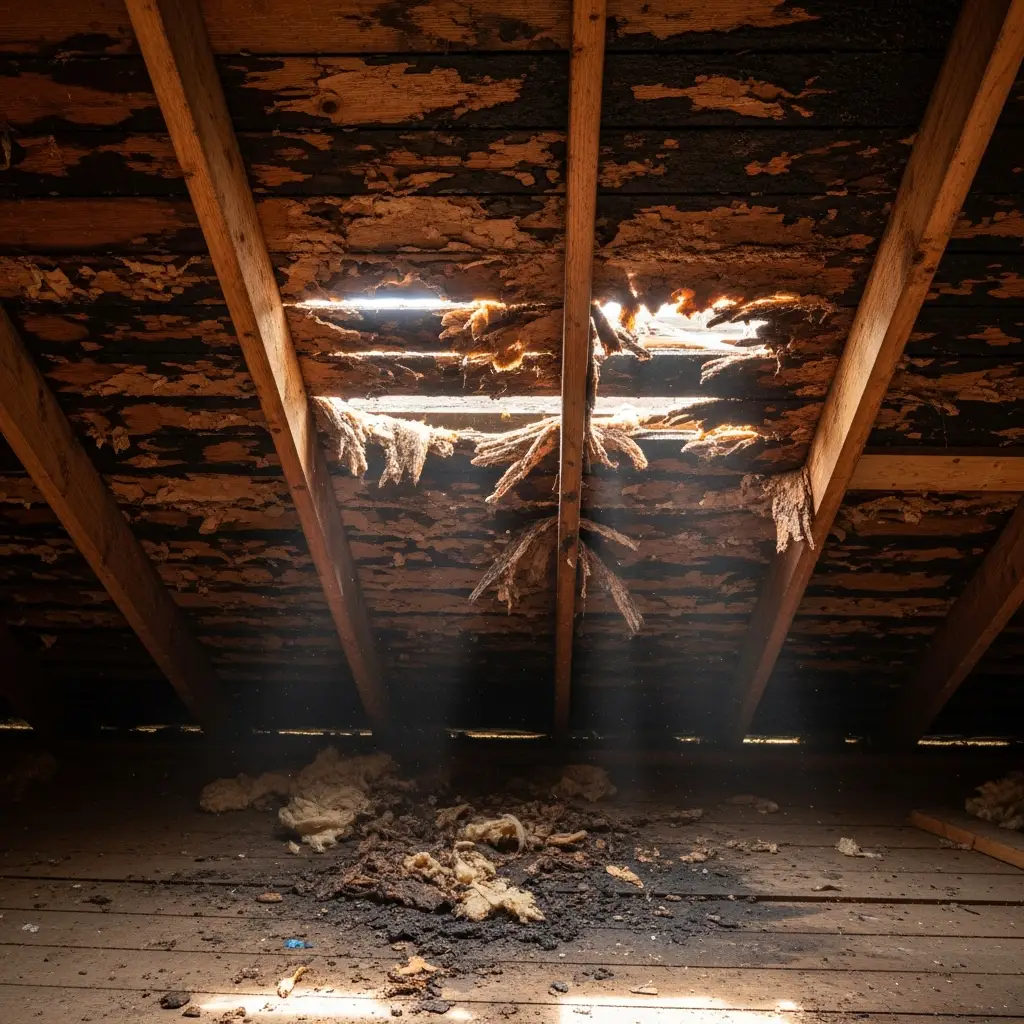
Don’t ignore attic warning signs! Dark stains, mold, and spongy decking mean it’s time for a professional roof inspection. Save money on future repairs with early detection.
Roof Decking and Different Roofing Systems
Not all roofing materials place the same demands on decking. Understanding the relationship between your roofing choice and decking requirements ensures optimal performance and longevity.
Asphalt Shingle Roofs
Asphalt shingles represent over 80% of residential roofing in the United States, and for good reason, they offer excellent performance at reasonable cost.
Decking Requirements for Shingles:
- Solid, continuous deck surface (no gaps)
- Smooth surface (no significant irregularities)
- Adequate fastener-holding capability
- Standard thickness: 1/2″ to 5/8″ depending on rafter spacing
Architectural Shingles: Architectural roof shingles and laminate shingles are thicker and heavier than traditional three-tab shingles, but they don’t require special decking considerations. Standard plywood or OSB handles their weight without issue.
Premium Shingle Products: High-end products like CertainTeed roof shingles, Certain Teed Landmark shingles, or Presidential roofing shingles offer enhanced durability and aesthetics but place similar demands on decking as standard products.
Common Shingle Issues Related to Decking:
- Telegraphing (deck irregularities visible through shingles)
- Premature wear from deck movement
- Fastener pull-through on deteriorated decking
- Moisture wicking through gaps in plank decking
Metal Roofing Systems
Metal roof installations have surged in popularity across Dallas, driven by their longevity, energy efficiency, and storm resistance. However, metal roofing places different demands on decking than shingles.
Metal Roof Decking Considerations:
Solid Deck Required: Unlike some applications where skip sheathing (spaced boards) is acceptable, most metal roofing manufacturers require continuous solid decking for warranty coverage. This provides:
- Consistent fastener base
- Thermal barrier
- Sound dampening
- Condensation protection
Deck Smoothness: Metal roofing telegraphs deck irregularities more readily than shingles. Warped boards, high nail heads, or gaps between panels show through metal more visibly. We take extra care leveling and preparing decks for metal installation.
Thermal Movement: Metal expands and contracts significantly with temperature changes. Decking must accommodate this movement without fastener failure. We use specialized fasteners with rubber washers that allow movement while maintaining seal integrity.
Slope Requirements: Understanding the minimum pitch for metal roof installations affects underlayment and deck preparation. Lower slopes require more attention to waterproofing details.
Special Considerations:
- Soundproofing metal roof often involves additional deck layers or specialized underlayment
- Can you paint metal roofs? Yes, but proper deck ventilation prevents condensation issues that damage paint from below
- Metal roof longevity (40-70 years) often exceeds deck lifespan, requiring mid-life deck replacement
Flat and Low-Slope Roofing
Residential flat roof systems require specialized deck preparation. Despite the name, truly flat roofs don’t exist—all roofs need at least minimal slope for drainage.
Flat Roof Decking Materials:
- Plywood or OSB (residential)
- Metal decking (commercial)
- Concrete (high-rise or specialty applications)
- Lightweight insulating concrete over metal deck
Waterproofing Emphasis: Flat roofs rely entirely on membrane integrity since they shed water slowly. Decking must be:
- Perfectly smooth (no protruding fasteners)
- Free of gaps or openings
- Properly sloped to drains (minimum 1/4″ per foot)
- Compatible with membrane adhesives
Common Flat Roof Systems:
EPDM Roofing: EPDM roofing (rubber membrane) is popular for flat applications. The membrane adheres directly to decking or insulation layers, requiring smooth, clean surfaces.
TPO and PVC: These single-ply membranes offer excellent durability and energy efficiency. They’re heat-welded at seams, requiring stable decking that won’t shift or move.
Built-Up Roofing (BUR): Traditional tar-and-gravel roofs use multiple layers of felt and asphalt. The weight (6-8 pounds per square foot) requires sturdy decking and proper structural support.
Rubber Roofing: Rubber roofing for flat roofs provides excellent waterproofing. Installation requires meticulous deck preparation—any irregularity creates potential leak points.
Flat Roof Conversions: Increasingly, homeowners ask about how to turn flat roof into deck. This requires:
- Structural engineering assessment
- Reinforced decking and supports
- Proper waterproofing beneath deck surface
- Code-compliant railings and access
- Drainage solutions
Creating a waterproof deck roof involves multiple waterproofing layers and careful detail work at all penetrations and edges.
Specialty Roofing Materials
Slate Roofing: Slate roofing represents the premium end of roofing materials, with weights ranging from 800 to over 1,500 pounds per square. This extreme weight requires:
- Thicker decking (typically 3/4″ minimum)
- Closer rafter spacing (often 12-16″ on center)
- Structural engineering for retrofits
- Extra blocking and support at eaves and ridges
In Dallas, we occasionally work on historic homes with original slate roofs. The engineering required for these installations far exceeds standard roofing projects.
Composition Roofing: The term composition roof typically refers to asphalt shingles, though it can include other composite materials. Standard decking practices apply.
Mansard Roofs: The distinctive mansard roof style features two slopes on each side, with the lower slope much steeper than the upper. This creates complex deck framing and requires careful attention to transitions between sections.
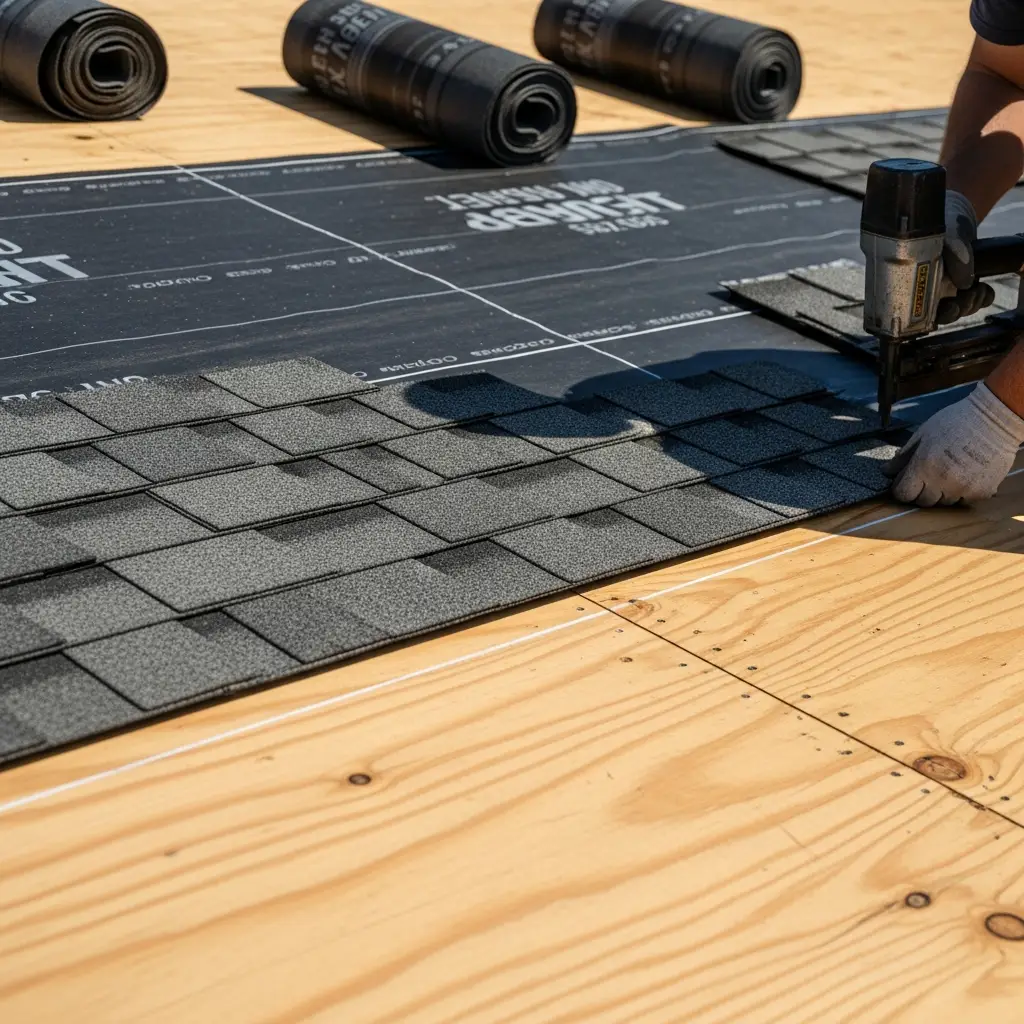
Proper decking is crucial for shingle longevity. Ensure correct fastener placement and overlap to prevent premature wear and potential leaks!
Waterproofing and Protection Systems
Quality decking provides the foundation, but proper protection systems ensure longevity. After installing thousands of roofs across Dallas, I’ve learned that the difference between a 20-year roof and a 40-year roof often comes down to waterproofing details.
Understanding Roof Deck Protection
What is roof deck protection? It’s the system of materials and techniques that shield your decking from moisture infiltration. This includes underlayment, ice and water shield, and proper flashing integration.
Why Deck Protection Matters: Even the best decking deteriorates when exposed to moisture. Protection systems provide:
- Secondary water barrier if primary roofing fails
- Moisture vapor management
- Temporary weather protection during installation
- Extended deck lifespan
- Leak prevention at vulnerable areas
Underlayment Types and Selection
Choosing the best roof underlayment depends on your roofing material, climate, and budget.
Traditional Felt Paper:
- #15 felt: Lightweight, economical ($15-25 per roll)
- #30 felt: Heavier, more durable ($25-40 per roll)
- Breathable (allows moisture vapor to escape)
- Limited lifespan if exposed to weather
- Can wrinkle when wet
Synthetic Underlayment:
- Superior tear resistance
- Longer exposure rating (up to 6 months)
- Lighter weight than felt
- Better UV resistance
- Higher cost ($60-120 per roll)
- May require special installation in extreme heat
Self-Adhering Membranes: Peel and stick roof underlayment offers the ultimate protection at vulnerable areas:
- Complete waterproof barrier
- Self-seals around fasteners
- Excellent for valleys, eaves, and penetrations
- Premium cost ($100-200 per roll)
- Can be difficult to reposition during installation
Installation Best Practices:
- Install underlayment over clean, dry decking
- Overlap properly (typically 6″ side laps, 4″ end laps)
- Start at eaves and work toward ridge
- Seal all fasteners in self-adhering products
- Don’t leave exposed to weather longer than manufacturer allows
In Dallas’s intense summer heat, we’re careful with self-adhering products. Above 95°F, they can become too tacky to handle properly. We schedule installation for morning hours when temperatures are more manageable.
Critical Protection Areas
Eaves and Rakes: The roof eave (horizontal lower edge) is highly vulnerable to ice dams and wind-driven rain. We install ice and water shield along the entire eave, extending at least 24″ past the interior wall line.
Valleys: These water-concentrating areas require extra protection. We use either:
- Full self-adhering membrane coverage
- Double-layer synthetic underlayment
- Metal valley flashing over underlayment
Penetrations: Every pipe, vent, chimney, and skylight creates a potential leak point. Proper roof flashing around these penetrations is critical. We use:
- Self-adhering membranes around penetration bases
- Metal or specialty flashings properly integrated with roofing
- Counter flashing roof systems at chimneys and walls
- Quality roof vent pipe boot replacement products designed for your roofing type
Drip Edge Integration: Installing drip edge on roof perimeters protects fascia boards and helps water sheet properly off the roof. Proper sequence matters:
- Install drip edge at eaves BEFORE underlayment
- Install drip edge at rakes OVER underlayment
- This sequence channels water correctly away from the deck
Flashing Systems
Beyond penetrations, proper flashing systems protect deck edges and transitions:
Step Flashing: At wall intersections, L-shaped metal pieces integrate with each shingle course, creating a shingled waterproof transition.
Apron Flashing: At the base of chimneys and walls, apron flashing directs water over shingles and away from the intersection.
Cricket or Saddle: Behind large chimneys, a mini-roof structure diverts water around the chimney rather than allowing it to dam behind the structure.
Kickout Flashing: Where roof lines intersect walls above seamless gutters installation, kickout flashing directs water into gutters rather than behind siding.
Poor flashing accounts for the majority of leak-related deck damage we encounter. A $50 piece of flashing installed correctly prevents thousands in water damage repairs.
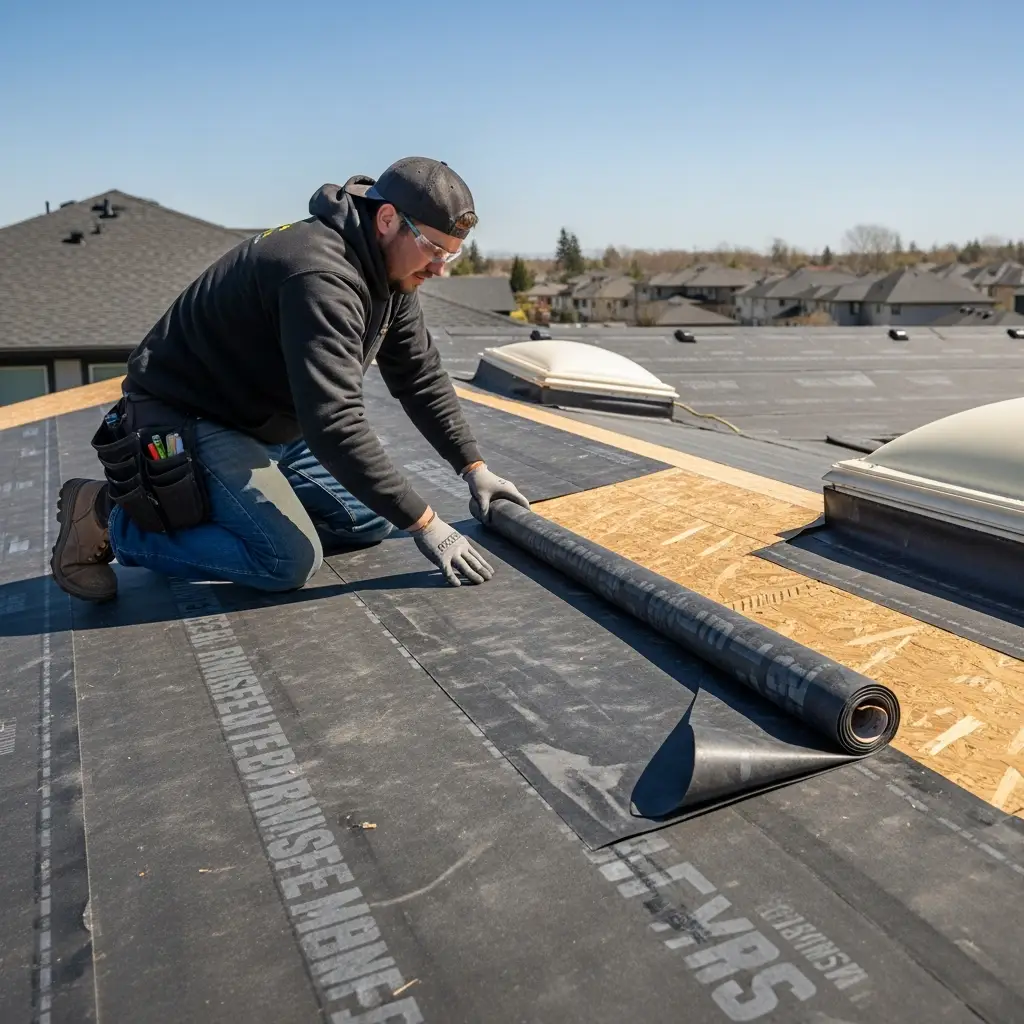
Ensure a long-lasting roof with proper underlayment. Self-adhering membranes provide superior waterproofing in vulnerable areas. Learn which option is best for your needs.
Insulation and Energy Efficiency
Your roof deck plays a significant role in your home’s thermal performance. In Dallas, where cooling costs dominate energy bills, optimizing deck-related energy efficiency pays dividends.
Deck Contribution to Thermal Performance
Heat transfer through roofs occurs via three mechanisms:
- Conduction: Heat passing directly through materials
- Convection: Air movement transferring heat
- Radiation: Heat radiating from hot surfaces to cooler ones
Traditional decking addresses only conduction. Radiant barrier products tackle radiation, while proper ventilation manages convection.
Understanding R-Value
What Is R-Value?: R-value for attic insulation measures resistance to heat flow. Higher R-values indicate better insulating properties. For Dallas:
- Minimum recommended: R-30
- Better performance: R-38
- Optimal: R-49 or higher
Decking’s R-Value: Standard 1/2″ plywood provides R-0.62—minimal insulation. The deck itself contributes little to thermal resistance. However, the deck supports insulation systems and manages moisture vapor transmission.
Radiant Barrier Decking
Radiant barrier roof decking represents one of the most effective energy upgrades for Texas homes. Here’s why it works:
The Science: Solar radiation heats your roof surface to 150-180°F on summer afternoons. This heat radiates downward into the attic. Traditional decking absorbs this radiation, heats up, and conducts heat into the attic space.
Radiant barrier decking’s reflective surface reflects up to 97% of radiant heat back toward the roof surface, preventing it from heating the attic mass.
Performance Data: Studies by the Florida Solar Energy Center and Oak Ridge National Laboratory demonstrate:
- Attic temperature reduction: 20-30°F
- Cooling cost reduction: 5-10%
- Peak demand reduction: 8-12%
- Roof surface temperature: slightly higher (usually not problematic)
Installation Requirements:
- Reflective surface must face air space (toward attic)
- Minimum 3/4″ air gap required for effectiveness
- Works best with adequate ventilation
- Can be combined with traditional insulation
Cost-Benefit: Radiant barrier decking adds approximately $0.10-0.15 per square foot to material costs. For a 2,000 square foot roof, that’s $200-300. With annual cooling savings of $100-150, payback occurs within 2-3 years.
We recommend radiant barrier decking for virtually all Dallas-area roof replacements. The modest upfront investment delivers returns throughout the roof’s lifetime.
Spray Foam and Insulation Integration
Spray foam roof insulation creates an air-sealed, highly insulated roof deck assembly. This approach differs from traditional ventilated attic construction:
Traditional Approach:
- Insulation on attic floor
- Ventilated attic space
- Deck exposed to attic air
Spray Foam Approach:
- Insulation applied directly to underside of deck
- Unventilated attic (conditioned space)
- Deck becomes part of building thermal envelope
Spray Foam Benefits:
- Superior air sealing
- High R-value per inch
- Eliminates duct losses in attic
- Prevents ice damming (in applicable climates)
- Reduces air infiltration
Spray Foam Considerations:
- Higher upfront cost ($1.50-3.50 per board foot)
- Requires code-compliant thermal barrier
- May void some roofing warranties if deck can’t breathe
- Complicates roof replacement (can’t inspect deck from below)
Roof Insulation Best Practices
Regardless of roof insulation approach, proper installation requires:
Adequate Ventilation (for traditional approaches):
- Soffit vents for intake air
- Ridge or roof vents for exhaust
- Minimum 1:150 ventilation ratio (can reduce to 1:300 with proper intake/exhaust balance)
- No insulation blocking soffit ventilation paths
Moisture Management:
- Vapor barriers on warm side of insulation (below insulation in attics)
- Adequate ventilation to remove moisture
- Sealed penetrations to prevent moisture-laden air from entering attic
Insulation Depth:
- Don’t compress insulation (reduces R-value)
- Maintain ventilation channels above insulation
- Use baffles at soffits to preserve air paths
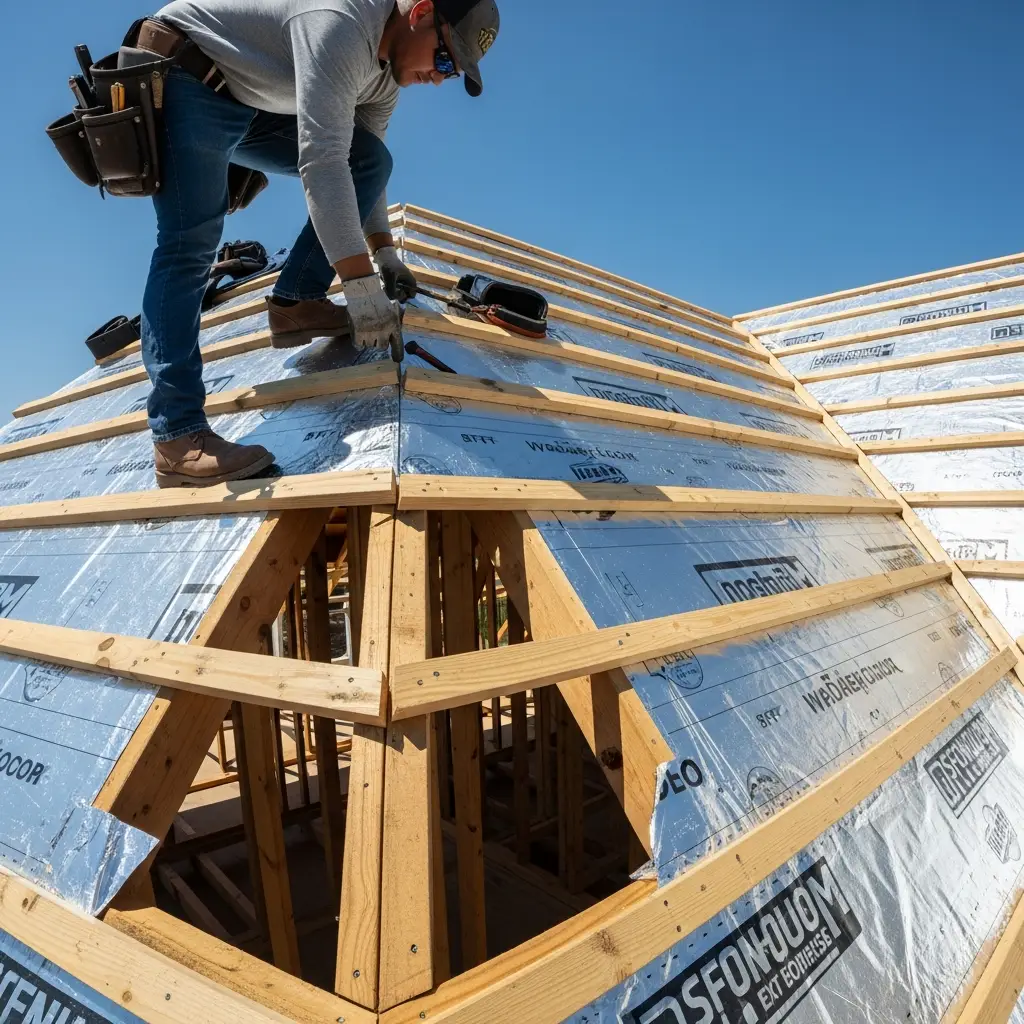
Radiant barrier decking reflects heat, reducing attic temperatures and cooling costs. A smart upgrade for Dallas homes, offering long-term energy savings!
Ventilation and Moisture Control
Proper roof ventilation protects your deck from moisture damage and extends roof life. This critical aspect often gets overlooked, leading to premature failure.
Why Ventilation Matters
Heat Removal: In summer, attic temperatures can reach 150°F or higher. This extreme heat:
- Accelerates shingle aging
- Increases cooling loads
- Can warp or damage decking
- Degrades adhesives and fasteners
Proper ventilation reduces attic temperatures by 20-40°F, extending material life and reducing energy costs.
Moisture Removal: In winter (even mild Dallas winters), moisture from living spaces migrates into attics through air leakage and vapor diffusion. Without ventilation, this moisture:
- Condenses on cold decking
- Promotes mold and mildew growth
- Rots wood decking and rafters
- Reduces insulation effectiveness
Types of Roof Vents
Ridge Vents: Continuous vents along the roof ridge provide excellent exhaust ventilation. Benefits:
- Weather-resistant (properly installed models shed water effectively)
- Aesthetically pleasing (blend with roof lines)
- Efficient (work with natural convection)
- Continuous coverage along entire ridge
Box Vents: Also called turtle vent roof or louver vents, these individual units install over holes cut in decking. They’re economical but less effective than continuous ridge vents.
Power Vents: Electric or solar-powered fans actively exhaust attic air. While effective at moving air, they:
- Can create negative pressure that pulls conditioned air from living spaces
- Require maintenance
- May short-circuit natural ventilation
- Cost more to install and operate
Soffit Vents: These intake vents are critical but often neglected. Without adequate intake ventilation, exhaust vents can’t function properly. Blocked soffit vents cause:
- Reduced air flow through attic
- Moisture accumulation
- Overworked exhaust vents
Balanced Ventilation
The Key Principle: Intake area should equal or slightly exceed exhaust area. This creates balanced air flow:
- Cool outside air enters at soffits
- Air warms as it rises through attic
- Warm air exhausts at ridge or upper vents
- Continuous air flow removes heat and moisture
Calculating Needs: Building codes typically require 1 square foot of net free ventilation area per 150 square feet of attic floor (can reduce to 1:300 with balanced intake/exhaust).
For a 2,000 square foot attic:
- Minimum ventilation: 13.3 square feet (1:150 ratio)
- Preferred ventilation: 20+ square feet
- Split 50/50: 10 square feet intake, 10 square feet exhaust
Common Ventilation Mistakes
Mixing Vent Types: Combining ridge vents with gable vents or box vents near the ridge short-circuits air flow. Air takes the path of least resistance, exiting through the closest vent rather than traveling the full length of the attic.
Insufficient Intake: We regularly encounter homes with adequate ridge vents but blocked or insufficient soffit vents. This creates negative pressure, reducing ventilation effectiveness.
Insulation Blocking Vents: Blown-in insulation sometimes blocks soffit ventilation paths. Installing proper baffles prevents this.
Over-Ventilation: While rare, excessive ventilation can create negative pressure that pulls conditioned air from living spaces, increasing energy costs.
Addressing Roof Vent Leaks
Roof vent leaks damage decking around vent penetrations. Common causes:
- Improperly installed flashing
- Cracked vent housings
- Missing or damaged sealant
- Wind-driven rain penetration
- Ice damming around vents
Proper installation with quality materials prevents most vent leaks. When we install roof vents, we:
- Use self-adhering membrane around vent openings
- Install proper counterflashing integrated with roofing
- Seal all fastener penetrations
- Verify adequate clearance for shingle integration
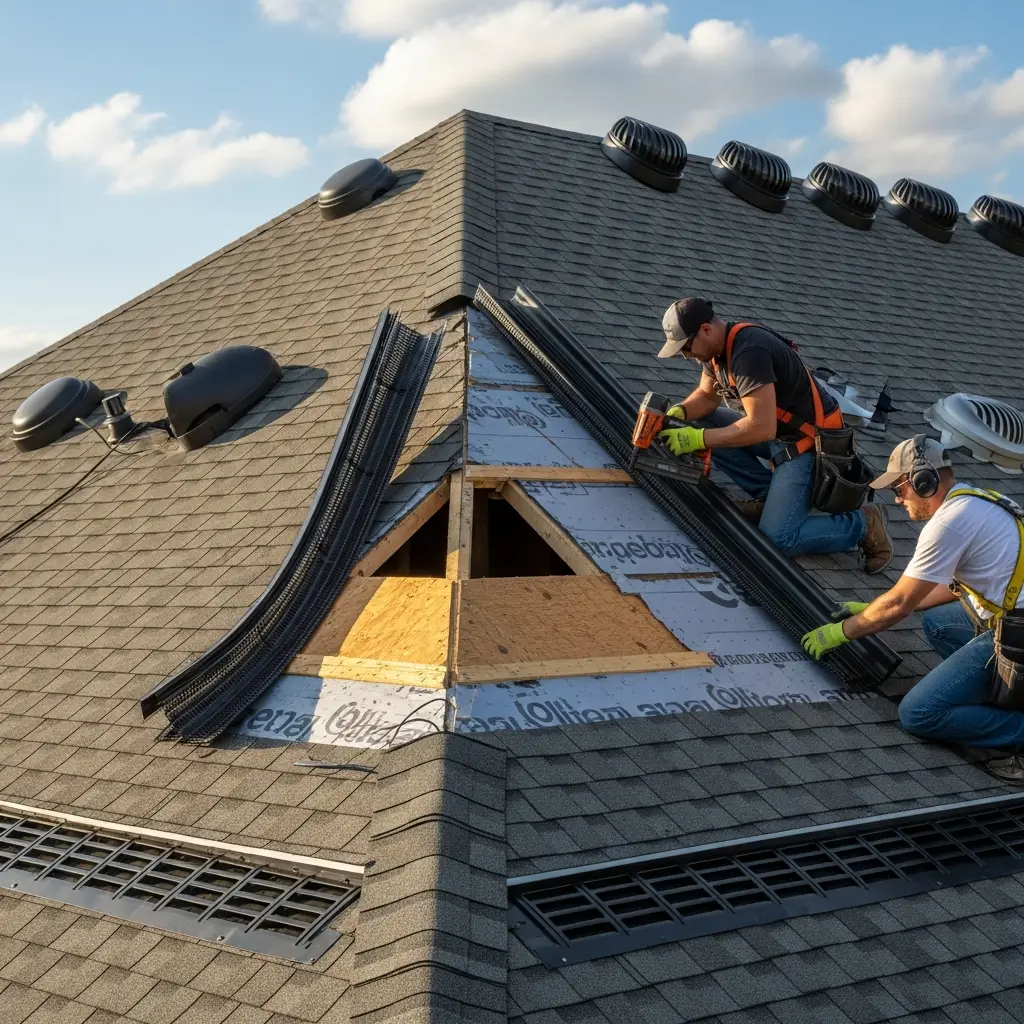
Ventilation and Moisture Control
Common Roof Decking Problems and Solutions
Through years of repair work across Dallas, I’ve encountered virtually every deck problem imaginable. Understanding common issues helps homeowners identify problems early, when repairs are less expensive.
Leak-Related Damage
Identifying Leak Sources: Water damage to decking rarely occurs directly below the actual leak. Water enters through one opening, travels along rafters or underlayment, then drips onto decking at a different location.
Common Entry Points:
- Damaged or missing shingles
- Failed flashing around penetrations
- Roof vent leaks
- Valley problems
- Ridge vent gaps
- Chimney flashing failures
Metal Roof Leak Issues: How to fix a leaking metal roof often involves identifying failed fastener seals or panel separation. Metal roofs have fewer leak points than shingles, but when they leak, water can travel extensively before becoming visible.
Small Leak Repairs: Addressing small roof leak repair promptly prevents major deck damage. A $200 repair today prevents a $2,000 deck replacement tomorrow.
Structural and Wind Damage
Wind Damage Assessment: Wind damage roof repair requires examining both surface materials and deck integrity. High winds can:
- Uplift sections of decking if improperly fastened
- Drive rain under shingles, saturating decking
- Tear fasteners through damaged deck material
- Cause deck failure at weak points
After severe storms, we examine:
- Fastener pattern and spacing
- Deck attachment quality
- Signs of water infiltration
- Structural movement or separation
Granular Loss: Granular loss roof sometimes results from deck problems. Buckling or warped decking can abrade shingle granules from below, accelerating shingle aging.
Improper Installation Issues
Fastener Problems: Common fastening errors that damage decking:
- Overdriven fasteners (break surface, reduce holding power)
- Underdriven fasteners (don’t seat properly, create bumps)
- Wrong fastener type (corrode, pull through)
- Insufficient quantity (doesn’t meet wind resistance requirements)
Spacing Issues: Inadequate expansion gaps cause:
- Buckling during hot weather
- Compression damage at panel edges
- Telegraphing through roofing materials
- Accelerated deterioration
Poor Penetration Flashing: Every roof penetration requires proper flashing. Shortcuts during installation lead to leaks that damage surrounding decking.
Maintenance and Age-Related Issues
Ceiling Stain Management: Learning how to remove water stains from ceiling addresses cosmetic issues, but stains indicate water reached the deck. Even if current leaks are fixed, previous water damage may have compromised deck integrity.
Algae and Organic Growth: Black algae on roof surfaces indicates moisture retention. While algae primarily affects shingles, persistent moisture creates conditions for deck deterioration.
Age-Related Deterioration: Understanding roof age helps predict deck replacement needs. Even quality decking eventually deteriorates from:
- UV exposure (at gaps and exposed areas)
- Thermal cycling (expansion/contraction)
- Moisture absorption/release cycles
- Fastener corrosion
- General material aging
Condensation and Moisture Control
Roof condensation represents one of the most insidious deck problems because it occurs from below, often going unnoticed until significant damage accumulates.
Condensation Causes:
- Inadequate ventilation
- Air leakage from living spaces into attic
- High interior humidity
- Temperature differentials
- Missing or damaged vapor barriers
Prevention Strategies:
- Maintain proper ventilation (as discussed in ventilation section)
- Seal air leaks from living spaces into attic
- Manage interior humidity levels
- Ensure proper vapor barrier installation
- Address sources of excessive moisture (bathroom fans venting to attic, etc.)
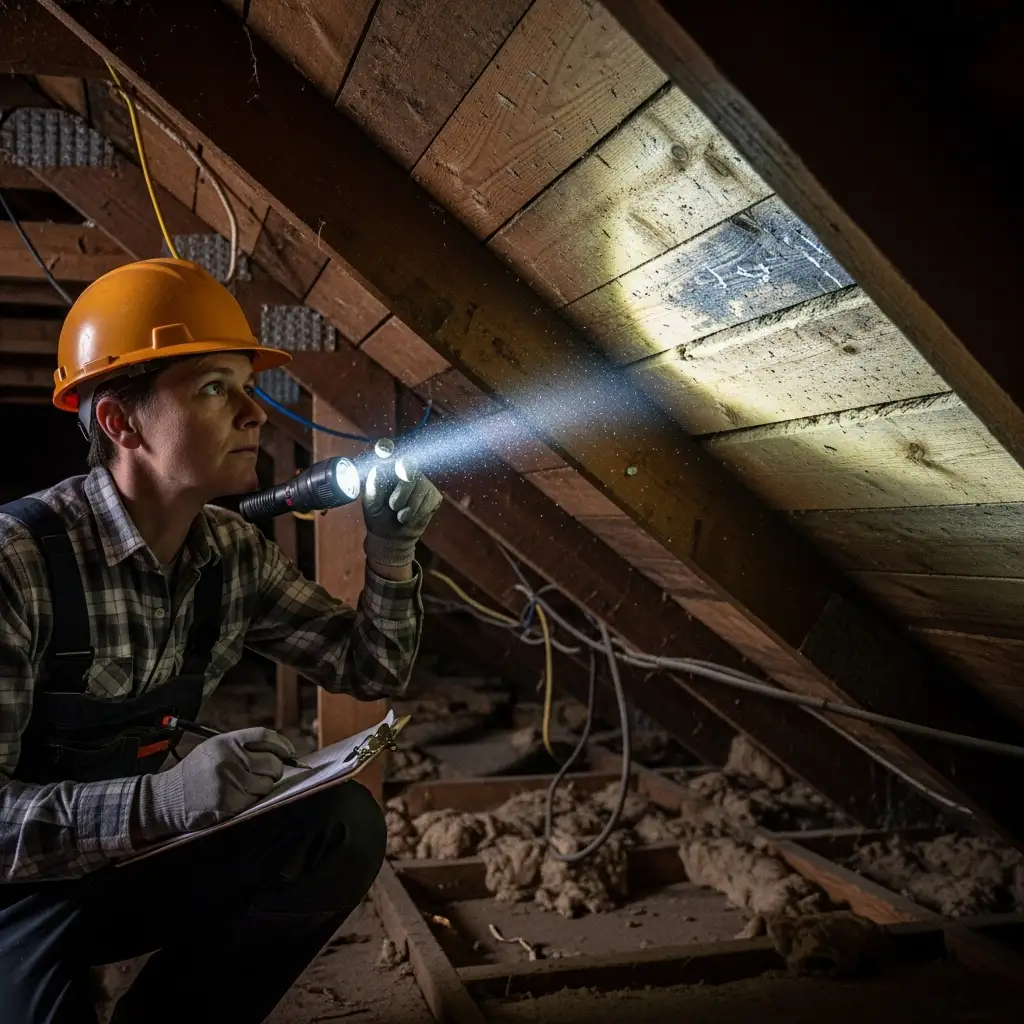
Common Roof Decking Problems and Solutions
Maintenance and Inspection
Proactive maintenance extends deck life and prevents expensive emergency repairs. After decades in the roofing business, I’ve seen how simple maintenance saves homeowners thousands of dollars.
Regular Inspection Schedule
Annual Inspections: Every roof benefits from annual roof inspection, ideally in spring after winter weather and before summer heat. Many homeowners ask how long does a roof inspection take a thorough inspection typically requires 45-90 minutes.
What to Look For:
From the Ground:
- Obvious sagging or irregularities
- Missing or damaged shingles
- Moss or algae growth
- Debris accumulation in valleys
- Damaged flashing
- Signs of animal activity
From the Attic:
- Light penetration through deck
- Water stains on decking or rafters
- Sagging between rafters
- Mold or mildew growth
- Adequate insulation coverage
- Proper ventilation function
On the Roof (if comfortable and safe):
- Shingle condition
- Flashing integrity
- Vent condition
- Valley cleanliness
- Fastener condition
- Deck softness or bounce
Preventive Maintenance Tasks
Gutter Maintenance: While seemingly unrelated to decking, proper seamless gutters installation and maintenance prevents water from backing up under shingles and saturating deck edges. Understanding how are seamless gutters made helps appreciate their leak-free performance.
Debris Removal: Clean your roof seasonally:
- Remove leaves and branches
- Clear valleys completely
- Clean gutters and downspouts
- Trim overhanging branches
Minor Repairs: Address small issues immediately:
- Replace damaged shingles
- Reseal exposed fasteners
- Repair minor flashing gaps
- Fix roof vent leaks promptly
When to Call Professionals
Some maintenance requires professional expertise:
- Any work requiring walking on steep roofs
- Structural concerns (sagging, damage)
- Extensive leak tracking
- Major repairs affecting deck integrity
- Work above two stories
Safety should always be your primary concern. Professional roofers have proper equipment, insurance, and experience to work safely at heights.
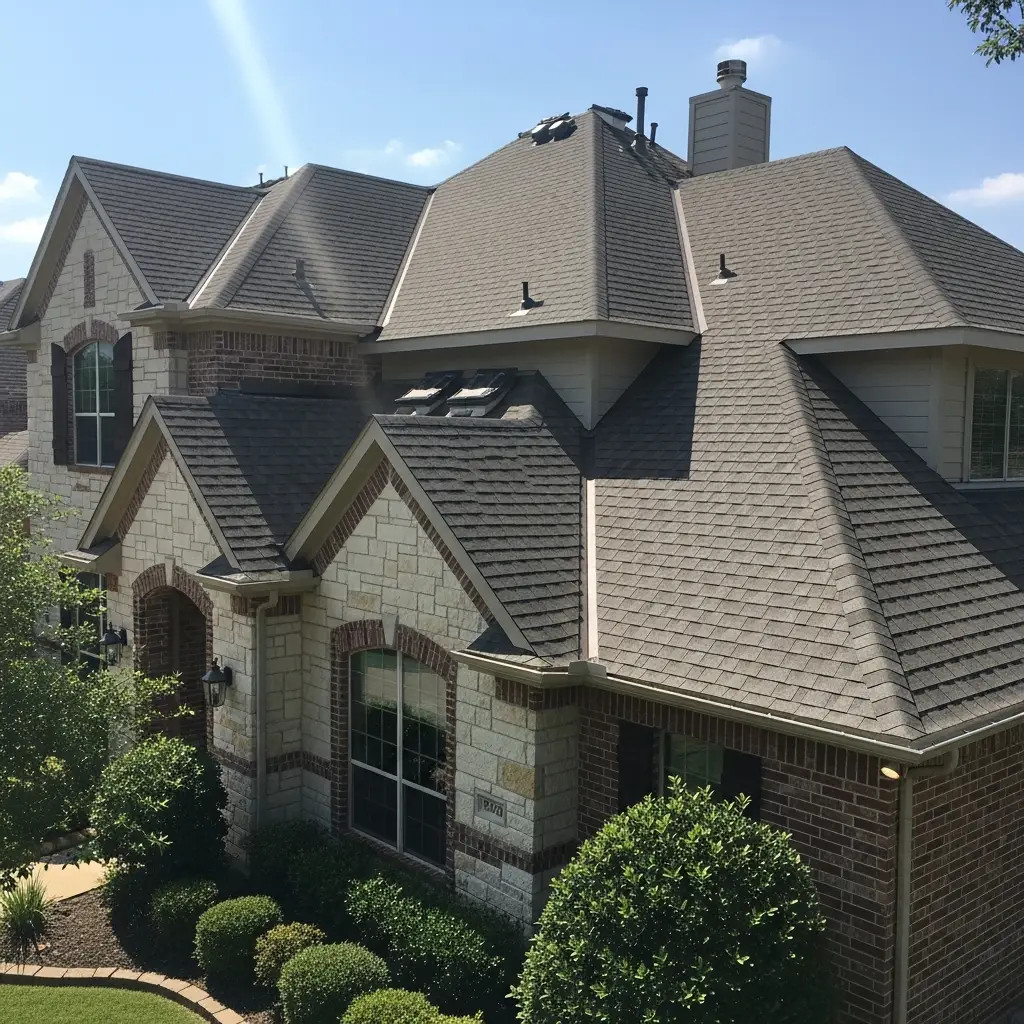
Maintenance and Inspection
Special Considerations and Advanced Topics
Climate-Specific Challenges
Cold Weather Roofing: While Dallas enjoys mild winters, we occasionally face challenging conditions. Roofing in the winter presents unique challenges:
- Shingles become brittle below 40°F
- Adhesive strips don’t activate properly
- Moisture doesn’t evaporate readily
- Worker safety concerns
For contractors serving colder regions like roofing in Wisconsin, these challenges are routine. Proper techniques include:
- Using cold-weather shingle formulations
- Hand-sealing shingle tabs
- Protecting materials from freezing
- Ensuring decks are completely dry before covering
Hot Weather Considerations: Dallas summers regularly exceed 100°F, creating different challenges:
- Self-adhering products become too tacky
- Workers face heat stress
- Materials can become damaged from overheating
- Decking can warp if installed too hot
We schedule intensive deck work for morning hours when temperatures are manageable, taking frequent breaks to prevent heat-related illness.
Roof Deck Conversions and Specialty Applications
Creating Usable Space: The question of how to turn flat roof into deck requires careful engineering and planning:
Structural Requirements:
- Verify existing structure can support increased loads (40-60 psf for deck areas)
- Add structural reinforcement as needed
- Ensure proper drainage (water must flow away from deck)
- Install code-compliant railings
Waterproofing Requirements:
- Create waterproof deck roof beneath walking surface
- Use commercial-grade membranes designed for traffic
- Detail all penetrations meticulously
- Provide access for future membrane inspection/repair
Code Compliance:
- Obtain required permits
- Meet egress requirements
- Install proper railings (minimum 36-42″ height)
- Verify fire separation requirements
- Ensure structural adequacy
Raising Roof Lines
Raising the roof on a house involves complete deck replacement as part of extensive structural modifications. This complex project requires:
- Structural engineering
- Permit acquisition
- Temporary weatherproofing during construction
- Complete roofing system replacement
- Significant investment ($15,000-100,000+ depending on scope)
We occasionally encounter these projects when homeowners want to add living space, create cathedral ceilings, or improve attic headroom.
Emergency Repairs and Temporary Solutions
Temporary Waterproofing: When immediate repair isn’t possible, temporary solutions can prevent further damage:
- Tarps properly secured
- Emergency patch materials
- Flex Seal roof products (temporary use only)
- Temporary flashing repairs
Storm Damage Response: After severe weather, addressing storm damage roof replacement needs quickly prevents secondary damage. Water infiltration through damaged roofs can destroy decking, insulation, and interior finishes within days.
Integration with Other Building Systems
Siding Coordination: Siding replacements often occur simultaneously with roofing projects. Proper integration requires:
- Correct flashing at roof-wall intersections
- Kickout flashing where roof meets siding above gutters
- Step flashing coordination
- Sealant compatibility
Gutter Systems: Comparing seamless gutters vs traditional options affects how roof edges are detailed. Seamless half round gutters require different edge flashing than standard K-style gutters.
Special Considerations and Advanced Topics
Specialized Roofing Scenarios
Calculating Roofing Materials
Understanding what is a roofing square helps homeowners comprehend estimates and figure roofing requirements. A square equals 100 square feet of roof surface.
Material Calculations:
- Measure roof length and width for each section
- Multiply to get square footage
- Divide by 100 to get squares
- Add 10-15% for waste and complexity
- Account for valleys, hips, ridges separately
Working with Insurance and Financing
Insurance Claims: Learning how to get insurance to pay for roof replacement requires understanding your policy and claim process:
Documentation Steps:
- Photo document all damage immediately
- Prevent further damage (temporary repairs)
- Contact insurance promptly
- Obtain professional inspection/estimate
- Review adjuster findings carefully
- Negotiate if initial offer seems inadequate
- Understand depreciation vs. replacement cost coverage
Financing Options: For out-of-pocket expenses, exploring how to finance a new roof makes essential repairs affordable:
- Home equity loans/lines of credit
- Personal loans
- Contractor financing programs
- Credit cards (for smaller amounts)
- FHA 203(k) renovation loans
- State/local energy efficiency programs
Budget-Conscious Options
Inexpensive Roofing: Homeowners seeking inexpensive roofing solutions should understand that low-cost doesn’t mean low-quality. Budget options include:
- Standard three-tab shingles
- Architectural shingles (mid-grade)
- Basic metal roofing
- Modified bitumen for flat roofs
- Strategic repair rather than full replacement
Cost-Saving Strategies:
- Replace only damaged deck sections rather than entire roof
- Choose cost-effective materials appropriate for your climate
- Schedule work during off-season (late fall, early winter in Dallas)
- Get multiple quotes from reputable contractors
- Consider phased approaches for large projects
- Maintain existing roof to extend lifespan
Understanding Comprehensive Replacement: Knowing what does roof replacement include prevents surprise costs and ensures you’re comparing equivalent proposals when soliciting bids.
Specialized Roofing Scenarios
Conclusion
After eight years installing and repairing roofs across Dallas’s diverse building landscape, I’ve learned that roof decking represents the unsung foundation of every successful roofing system. While homeowners understandably focus on visible elements like shingles or metal panels, the deck beneath determines whether your roof lasts 15 years or 50 years.
Quality decking properly installed provides:
- Structural integrity supporting your entire roofing system
- Weatherproofing foundation enabling effective moisture protection
- Energy efficiency platform supporting insulation and radiant barriers
- Longevity that outlasts multiple roofing material replacements
Whether you’re planning a complete roof replacement, addressing storm damage roof replacement needs, or simply maintaining your home, understanding roof decking empowers you to make informed decisions.
Key takeaways from this comprehensive guide:
- Material selection matters: Choose plywood or OSB based on your climate, budget, and performance priorities. In humid climates like Dallas, plywood’s moisture resistance justifies the premium cost.
- Installation quality is critical: Proper spacing, fastening, and detail work prevent 90% of deck failures. Hire experienced contractors who follow manufacturer specifications and building codes.
- Protection systems extend life: Quality underlayment, proper flashing, and adequate ventilation protect your investment and prevent premature deterioration.
- Regular maintenance pays dividends: Annual inspections and prompt minor repairs prevent expensive major failures. The cost of prevention is always less than the cost of correction.
- Climate adaptation is essential: Dallas’s intense heat and occasional severe storms require specific approaches different from northern or coastal climates.
At DeckingHub, we’ve built our reputation on quality deck installation and honest assessment of deck conditions. Whether you need minor repairs or complete replacement, proper deck work provides the foundation for decades of reliable performance.
For homeowners evaluating roof projects, remember that your deck investment protects everything below it—your home’s interior, your belongings, and your family. Cutting corners on decking to save a few hundred dollars can cost thousands in future repairs.
For contractors and building professionals, staying current with best practices, materials, and code requirements ensures your projects perform as intended and your customers remain satisfied years after installation.
Frequently Asked Questions
How long does roof decking last?
Quality plywood or OSB decking typically lasts 30-50 years when properly protected from moisture. In Dallas’s climate with proper care, we regularly encounter 40+ year old decking still in serviceable condition. Conversely, improperly ventilated or leak-prone roofs can destroy decking in 10-15 years.
What’s the difference between roof decking and sheathing?
These terms are essentially synonymous. “Decking” and “sheathing” both refer to the structural panels installed over rafters or trusses. Some regions prefer one term over the other, but they describe the same component.
Does roof decking need to be replaced with every roof?
No. Many roof replacements involve only the surface materials (shingles, underlayment, flashing) while existing decking remains in place.
References and Citations
This comprehensive guide draws upon established building codes, industry standards, and professional experience. The following references provide authoritative information for those seeking additional technical details:
Building Codes and Standards
International Residential Code (IRC) 2021 Edition
- Chapter 8: Roof-Ceiling Construction
- Section R803: Roof Sheathing
- Section R806: Roof Ventilation
- Published by: International Code Council (ICC)
- Available at: https://www.iccsafe.org
International Building Code (IBC) 2021 Edition
- Chapter 15: Roof Assemblies and Rooftop Structures
- Section 1507: Requirements for Roof Coverings
- Published by: International Code Council (ICC)
ASTM International Standards
- ASTM D3043: Standard Methods of Testing Structural Panels in Flexure
- ASTM D1037: Standard Test Methods for Evaluating Properties of Wood-Base Fiber and Particle Panel Materials
- ASTM D2898: Standard Practice for Accelerated Weathering of Fire-Retardant-Treated Wood for Fire Testing
Industry Organizations and Resources
National Roofing Contractors Association (NRCA)
- Roofing Manual: Membrane Roof Systems
- Roofing Manual: Metal Panel and SPF Roof Systems
- Roofing Manual: Steep-Slope Roof Systems
- Website: https://www.nrca.net
APA – The Engineered Wood Association
- Panel Design Specification (PDS)
- Performance Rated Panels for Roof Sheathing
- Installation guidelines for structural panels
- Technical bulletins on moisture management
Asphalt Roofing Manufacturers Association (ARMA)
- Residential Asphalt Roofing Manual
- Proper ventilation requirements
- Deck preparation guidelines
Steel Deck Institute (SDI)
- Standard for Steel Roof Deck
- Design Manual for Composite Decks, Form Decks, and Roof Decks
- Installation guidelines
Energy and Environmental Standards
Department of Energy (DOE)
- Attic insulation recommendations by climate zone
- Radiant barrier effectiveness studies
- Energy-efficient roofing guidelines
Oak Ridge National Laboratory
- Studies on radiant barrier effectiveness
- Attic ventilation research
- Building envelope performance data
Florida Solar Energy Center
- Radiant barrier testing and performance data
- Ventilation studies for hot climates
- Cool roof technologies research
Manufacturer Technical Resources
While specific manufacturer guidelines vary, major producers of roof decking materials provide detailed technical documentation:
Georgia-Pacific
- OSB installation guidelines
- Performance specifications
- Warranty requirements
LP Building Products
- Engineered wood product specifications
- Installation manuals
- Moisture management guidelines
CertainTeed, GAF, Owens Corning (Roofing Manufacturers)
- Deck preparation requirements
- Underlayment specifications
- Installation guidelines for various roof types
Local Code Authorities
City of Dallas Development Services
- Local amendments to IRC/IBC
- Permit requirements
- Inspection procedures
Texas Department of Insurance
- Wind resistance requirements
- Installation standards for high-wind areas
- Insurance compliance guidelines
