
How to read a roof installation estimate before you sign
 By Jake Morrison, 8+ years in residential and commercial construction across Dallas and Fort Worth
·
By Jake Morrison, 8+ years in residential and commercial construction across Dallas and Fort Worth
·
A roof installation estimate you can actually rely on names five things: the total roof area in squares, the tear off, the deck repair rate, the exact shingle and underlayment products, and the fastener count per shingle. An estimate missing the deck rate is not a fixed price. It is a starting price.
Nine of ten bids look interchangeable at the total. The differences hide in what happens when the crew pulls the old roof off and finds soft plywood underneath.
Homeowners are told to get three estimates and pick the middle one. That advice assumes the three documents describe the same job. Usually they do not. One includes tearing the old roof off, one assumes going over the top of it. One prices deck repair at a stated rate per sheet, one leaves it blank and bills whatever the crew finds. The totals sit within a few hundred dollars of each other and the finished roofs are nothing alike.
This page walks the line items that separate a real number from a hopeful one, and it names the credentials that mean something. Some of them do not.
- Texas issues no state roofing license. Anyone can print a card and call themselves a roofer, so verification falls to you.
- The deck repair rate is the single line item that turns a fixed bid into a variable one. Typical exposure runs 5 to 15 percent of the deck area, which is $210 to $1,710 on a 2,000 square foot roof at published rates.
- Building code requires removal down to the deck on a replacement, with narrow exceptions, and forbids covering a roof that already carries two layers.
- Manufacturer certification is verifiable in a way that a license claim is not. Only GAF Master Elite contractors can register the Golden Pledge, and only CertainTeed SELECT ShingleMaster contractors can register the top SureStart PLUS coverage.
- On an insurance job in Texas, a contractor offering to cover your deductible is committing a Class B misdemeanor, and any contract over $1,000 paid from claim proceeds must carry a specific 12 point boldface notice.
What a roof installation estimate has to tell you
Contractors price by the square. One square is 100 square feet of roof surface, which is why a bid quoting a lump sum with no square count gives you nothing to compare against. A 2,000 square foot roof is 20 squares. If two bidders disagree about the square count, one of them measured and one of them guessed.
| Line item | What a usable estimate says | What a weak one says |
|---|---|---|
| Roof area | Squares, with pitch and number of facets noted | No number, or the house square footage instead of roof area |
| Tear off | Number of existing layers to be removed, disposal included | Silent, or "as needed" |
| Deck repair | A price per sheet or per square foot, and who decides it is needed | Blank, or "additional if required" |
| Shingle | Manufacturer, product line, color, wind and impact rating | "Architectural shingles" with no brand |
| Underlayment | Product name and where ice or water barrier goes | "Felt" |
| Fasteners | Nails per shingle, stated as a number | Nothing |
| Flashing and vents | New, reused, or replaced where deteriorated, itemized | Not mentioned, which usually means reused |
| Warranty | Manufacturer warranty name plus workmanship years in writing | "Lifetime warranty" |
| Payment schedule | Deposit, progress, and final amounts tied to milestones | Large deposit, remainder on completion |
Fastener count is the cheapest quality check on the list. Code sets a floor of four nails per strip shingle, or two per individual shingle, and manufacturers often require more in high wind zones. A crew running three nails per shingle installs faster, uses less material, and voids the manufacturer warranty. You cannot see it once the next course covers it, so it has to be in writing beforehand.
The deck line item, and why it decides your final price
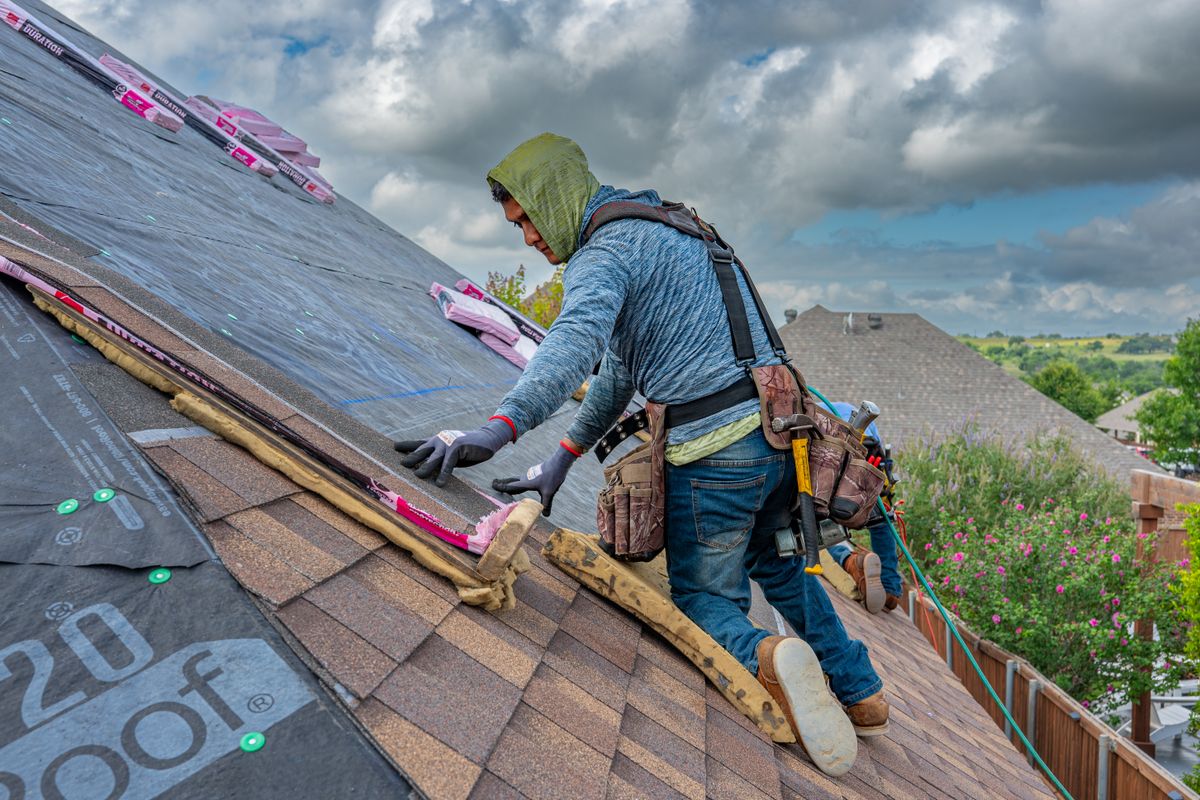
The old roof comes off on a Tuesday morning and for about two hours the deck is bare. That is the only window in the whole job when anyone can see the plywood. Whatever gets decided in those two hours lands on your invoice, and if the estimate never named a rate, it gets decided without you.
Some deck replacement on a re roof is normal, not a shakedown. Plywood and OSB soften around old nail holes, at valleys, and anywhere a flashing detail has been leaking quietly for years. A few sheets is expected. The question is whether you agreed on the price of a sheet before the crew arrived or after they were standing on your roof holding one.
Two rates are worth having in writing. The per sheet price for full sheet replacement, and whether partial repairs are billed at the same rate or by the square foot. Published 2026 figures put installed decking at $2 to $6 per square foot, which is $64 to $192 for a standard 4 by 8 sheet. Anything materially above that band deserves a question, and anything below it is probably a number that will change later.
Ask for photographs. A contractor who intends to bill you for nine sheets should have no difficulty photographing nine bad sheets before they go in the dumpster. We wrote the full breakdown of what drives those numbers in the cost to replace roof decking, and the structural side in replacing roof decking.
Tear off, layers, and what code actually requires
The biggest single variable between two bids is often whether the old roof comes off. Going over the top is faster and cheaper. It also buries whatever is wrong with the deck and adds weight the framing was not asked to carry.
The residential code is direct about it. Section R908.3 of the 2021 International Residential Code says roof replacement "shall include the removal of existing layers of roof coverings down to the roof deck," with a narrow exception for an adhered ice barrier membrane. Recovering rather than replacing is permitted under R908.3.1 in specific situations, including a standing seam metal system that carries its own load to the structure, and metal or tile applied over wood shakes.
R908.3.1.1 then names three cases where recovering is not allowed at all. Where the existing roof is water soaked or too deteriorated to serve as a base. Where the existing covering is slate, clay, cement, or asbestos cement tile. And where the roof already carries two or more applications of any covering.
That last one is the check a homeowner can run from the ground with a ladder and a flashlight at the eave. If you count two layers and someone is bidding a third, the bid is not legal and the permit inspector will say so. Local amendments vary, so confirm which code year your jurisdiction has adopted, but the two layer cap is close to universal.
| Approach | What happens to the old roof | Deck inspected | Relative cost |
|---|---|---|---|
| Full tear off | Removed down to the deck, hauled away | Yes, every square foot | Baseline |
| Recover over one layer | Stays, new covering goes on top | No | Roughly $1.00 to $1.75 per sq ft less |
| Recover over two layers | Not permitted under R908.3.1.1 | No | Fails inspection |
The saving on a recover is real, in the range of $1.00 to $1.75 per square foot of removal and disposal that you are not paying for. On a 20 square roof that is $2,000 to $3,500. It buys you a roof nobody has looked underneath, which is a reasonable trade on a sound deck and a bad one on a roof that has been leaking.
Licensed and insured means less than you think
Almost every roofing website in the country says licensed and insured. In Texas, half of that phrase is empty. The state does not license roofing contractors. The Roofing Contractors Association of Texas puts it plainly: the Texas Department of Licensing and Regulation "does NOT currently administer licensure for roofing contractors. Anyone can call themselves a roofer."
So when a Texas contractor tells you they are licensed, there is no state license to produce. There may be a city registration, a general contractor registration in another state, or a voluntary trade association membership. None of those is a roofing license, because no roofing license exists to hold. This is worth knowing mostly so the claim stops carrying weight in your decision, and so you spend your attention on the parts that can be checked.
Insurance is checkable, and it is the half of the phrase that matters. Two policies, both verified the same way.
| What to verify | How | What you are looking for |
|---|---|---|
| General liability | Certificate of insurance sent directly from the agent, not the contractor | Policy active on your installation dates, and a limit that covers your house |
| Workers compensation | Same, from the agent | Coverage for the crew who will physically be on your roof, including subcontracted crews |
| Business existence | Texas Secretary of State entity search, or your state equivalent | Registration date. A company formed six weeks after a hailstorm is a company formed for a hailstorm |
| Physical address | Look it up | An address, not a PO box and not a truck |
Insist the certificate comes from the insurance agent. A certificate forwarded by the contractor is a PDF, and a PDF is a thing anyone can edit. Calling the agent takes four minutes and is the highest value four minutes in the whole process. If a crew member is hurt on an uninsured job at your house, the exposure can land on your homeowners policy.
Manufacturer certification is the credential you can verify
Where a state license does not exist, manufacturer certification fills the gap. It is not a government credential and it does not test everything, but it has one property that matters: the manufacturer maintains the list, and you can search it yourself.
GAF runs four contractor levels. Master Elite sits at the top and is the level required to register the Golden Pledge warranty, which is GAF's strongest residential coverage. Reporting across the trade puts Master Elite at roughly 2 to 3 percent of GAF certified contractors nationally, and GAF's own warranty documentation states that Golden Pledge eligibility requires a Master Elite contractor. Silver Pledge sits a step below and also requires Master Elite.
CertainTeed works the same way with different names. ShingleMaster contractors can offer the improved SureStart PLUS coverage, and the top 5 Star coverage requires the higher SELECT ShingleMaster credential.
The practical point is that a manufacturer warranty is only as good as the installer's standing on the day it is registered. A contractor who has lapsed cannot register the coverage they promised you, and you will find that out at claim time rather than at signing.
Ask which warranty is being registered by name, ask whether the estimate includes the registration fee, and ask for the registration confirmation once the job is finished. An unregistered warranty is not a warranty.
Insurance jobs in Texas have rules with teeth
If a storm damaged your roof, the estimate arrives inside an insurance claim, and Texas law governs several things that contractors still offer to do.
The deductible is not negotiable. Section 707.002 of the Texas Insurance Code requires a person insured under a property insurance policy to pay any deductible applicable to a first party claim. Section 27.02 of the Business and Commerce Code makes it an offense for a seller of goods or services paid from claim proceeds to pay, waive, absorb, rebate, or otherwise help the insured avoid paying that deductible without the insurer's consent. It is a Class B misdemeanor. This came in through HB 2102 and took effect on September 1, 2019.
Section 27.02 also requires specific wording. Any contract for goods or services reasonably expected to be paid wholly or partly from property insurance proceeds, with a price of $1,000 or more, must carry a notice in at least 12 point boldface type stating that Texas law requires the insured to pay the applicable deductible and that it violates Texas law for a seller to knowingly allow or assist a failure to pay it. Open the contract and look for that block of bold type. Its absence tells you the contractor either does not know the statute or does not follow it, and either answer is useful.
Your insurer can also require proof. Section 707.004 lets an insurer with replacement cost coverage refuse to pay withheld recoverable depreciation until it receives reasonable proof that you paid the deductible, which includes a canceled check, money order receipt, credit card statement, or an executed installment plan.
One more, and it is the one storm chasers cross most often. Section 4102.163 of the Insurance Code says a contractor "may not act as a public adjuster or advertise to adjust claims for any property for which the contractor is providing or may provide contracting services," whether or not they hold an adjuster license and whether or not you signed a power of attorney. A roofer can document damage and give you an estimate. Negotiating your claim on your behalf while also doing the work is not permitted.
Contract terms that decide who absorbs the surprises
The estimate becomes a contract, and a handful of clauses decide who pays when reality differs from the plan.
Payment schedule
A deposit covering material delivery is ordinary. A deposit approaching half the job before anyone has been on the roof is a financing arrangement, not a deposit. Tie the payments to milestones you can see: materials delivered, tear off complete, installation complete, final inspection passed. Hold a meaningful final payment until the last one clears.
Lien exposure, and the paperwork that governs it
In Texas, a mechanic's lien on a homestead only attaches if specific conditions are met, and they are strict. Section 53.254 of the Property Code requires a written contract executed before the material is furnished or the labor performed, signed by both spouses if the owner is married, and filed with the county clerk of the county where the homestead sits.
Those requirements exist to protect you, and they cut both ways. A contractor who starts work with nothing signed has weakened their own lien rights, which sounds convenient until you consider what else that tells you about how they run jobs. Subcontractor and supplier liens are a separate matter, which is why proof that suppliers were paid belongs with your final payment.
Change orders
One sentence, and it prevents most disputes. No additional work is performed and no additional amount is owed without a written change order signed by the homeowner beforehand. Deck replacement is the change order that shows up on nearly every job, which is exactly why the rate belongs in the original document.
Workmanship warranty
Separate from the manufacturer warranty and covering a different failure. The manufacturer covers the shingle. Workmanship covers the installation, and installation error causes most leaks on new roofs. One year is thin. Five to ten years is a genuine commitment. Either way it needs to name the company, the years, and what triggers a callback.
Permit and inspection
The estimate should say who pulls the permit and that the cost is included. A contractor who suggests skipping the permit is proposing that your roof never gets inspected, which suits them and not you.
What a fair price looks like right now
National figures spread widely because roof size, pitch, complexity, and local labor rates all move the number. Published 2026 data is useful for one thing, which is telling you whether a bid sits inside the normal band or outside it.
Per unit figures compare better across markets than totals do. Reported 2026 numbers put tear off and disposal at $1.00 to $1.75 per square foot, new covering material at $2.45 to $12.00 per square foot depending on product, labor at $150 to $300 per square, and decking at $2 to $6 per square foot installed. In Austin, architectural asphalt has been reported at $5.00 to $9.50 per square foot installed, with Class 4 impact resistant product at $6.00 to $11.00.
Red flags, ranked by how much they cost you
Not every warning sign carries the same weight. These are ordered by what they actually expose you to, worst first.
| Signal | Why it matters | What to do |
|---|---|---|
| Offers to cover your deductible | Class B misdemeanor in Texas, and the amount is padded into the price | End the conversation |
| Wants to handle the whole claim for you | Prohibited under Insurance Code 4102.163 where the same contractor does the work | End the conversation |
| No deck repair rate in the estimate | Turns a fixed price into an open one on the morning of tear off | Get the per sheet rate in writing or move on |
| Large deposit before materials arrive | Your money is funding another job, and you have no leverage left | Restructure to milestone payments |
| Certificate of insurance sent by the contractor | A PDF is editable, and uninsured injury on your roof can reach your policy | Ask the agent to send it directly |
| Price expires today | Pressure exists to stop you comparing, which means comparison would help you | Compare anyway |
| No brand or product line named | Product substitution happens after signing and you cannot prove what you bought | Require the product name and color in the contract |
| Bidding a third layer | Not permitted under R908.3.1.1 and will fail inspection | Get a bid for a tear off instead |
| Suggests skipping the permit | No inspection, and a problem at resale | Require the permit, in the estimate |
| Company registered weeks ago | Storm formed entities leave the market with the storm | Check the Secretary of State registration date |
The first two are disqualifying on their own. A contractor who opens with an illegal offer has told you how the rest of the job will go, and no price justifies starting there.
Twelve questions worth asking before you sign
Ask all of them of every bidder. The answers sort the field faster than the totals do.
- What is my roof area in squares, and how did you measure it?
- How many layers are on the roof now, and is this bid a tear off or a recover?
- What do you charge per 4 by 8 sheet of decking, and will you photograph what you replace?
- Which shingle, which product line, and what wind and impact rating?
- Which underlayment, and where does the ice or water barrier go?
- How many nails per shingle, and where are they placed?
- Is the flashing new, or reused?
- Which manufacturer warranty are you registering, and are you currently certified to register it?
- How many years is your workmanship warranty, and what triggers a callback?
- Who pulls the permit, and is it in this price?
- Will your own crew do the work, or a subcontracted crew, and who carries their workers compensation?
- What is the payment schedule, and what happens if the job runs past the finish date?
Question three is the one that changes the total most often, and question eight is the one most likely to produce a pause. Both are worth the mild awkwardness of asking.
If you are still deciding between systems rather than between contractors, our metal roofing guide covers the cost comparison against asphalt, and what a roof replacement includes walks the job itself from delivery to cleanup. To sanity check a square count before anyone visits, the roof pitch calculator converts footprint and pitch into actual roof area.
Frequently asked questions
Three is the usual advice and it holds, but only if you compare line items rather than totals. Two detailed estimates tell you more than five lump sums. Make sure all of them are pricing the same scope, particularly on tear off and deck repair, or you are comparing different jobs.
Roof area in squares, number of existing layers and whether they are being removed, a stated deck repair rate, the shingle manufacturer and product line, the underlayment product, fasteners per shingle, flashing and vent treatment, permit responsibility, the manufacturer warranty being registered, the workmanship warranty in years, the payment schedule, and a start and completion window. An estimate missing the deck rate is not a fixed price.
No. Texas does not license roofing contractors at the state level, and the Texas Department of Licensing and Regulation does not administer roofing licensure. Some cities require a local registration. Because the phrase carries no state meaning, verify insurance, business registration date, and manufacturer certification instead.
No. Texas Insurance Code 707.002 requires the policyholder to pay the deductible, and Business and Commerce Code 27.02 makes it an offense for a contractor paid from claim proceeds to pay, waive, absorb, rebate, or help you avoid it without the insurer's consent. It is a Class B misdemeanor. Contracts of $1,000 or more paid from claim proceeds must also carry a 12 point boldface notice saying so.
Published 2026 figures put installed decking at $2 to $6 per square foot, which is about $64 to $192 for a 4 by 8 sheet. Most re roofs need some. On a 2,000 square foot roof, replacing 5 to 15 percent of the deck works out to roughly $210 to $1,710. Get the per sheet rate in the estimate rather than after the old roof is off.
Sometimes. The 2021 IRC requires replacement down to the deck, then permits recovering in specific cases under R908.3.1, including standing seam systems that carry their own load and metal or tile over wood shakes. R908.3.1.1 forbids it where the existing roof is water soaked or deteriorated, where the covering is slate, clay, cement, or asbestos cement tile, or where two or more layers are already in place. Check which code year your jurisdiction has adopted.
Usually one of four things: fewer nails per shingle, felt instead of synthetic underlayment, reused flashing rather than new, or no deck repair allowance so the difference gets billed later. Occasionally it is a genuine efficiency. All four are answerable by asking, and all four are invisible once the roof is finished.
One to three days for an ordinary asphalt roof on a single family home, weather permitting. Steep pitch, multiple facets, tile, or metal push it longer. Deck replacement adds time on the day it is discovered, which is another reason to have the rate settled beforehand.
One hundred square feet of roof surface. Contractors price by the square, so a 2,000 square foot roof is 20 squares. Roof area is larger than the footprint of the house because of pitch, which is why the two numbers should never be used interchangeably in an estimate.
A deposit that covers material delivery is normal. A deposit approaching half the contract before work begins is not, and it removes your leverage. Tie payments to milestones you can verify, and hold a meaningful final payment until the permit inspection has passed.
The manufacturer warranty covers defects in the shingle. The workmanship warranty covers the installation, and installation error causes most leaks on new roofs. They are separate documents from separate parties, and the stronger manufacturer coverage often requires a certified installer to register it.
Have an estimate in hand? Let us read it with you
Send it over or call and we will walk the line items, tell you what is missing, and give you our own measured number for comparison. Residential and commercial, no obligation.
Call (281) 677-8586- 2021 International Residential Code, R908.3 and R908.3.1.1: replacement requires removal down to the roof deck; recover is not permitted over two or more existing applications. iccsafe.org
- 2021 International Residential Code, R905.2.6: asphalt shingles require not less than four fasteners per strip shingle or two per individual shingle. iccsafe.org
- Texas Insurance Code 707.002: the insured must pay any deductible applicable to a first party claim. statutes.capitol.texas.gov
- Texas Insurance Code 707.004: an insurer may withhold recoverable depreciation until it receives reasonable proof the deductible was paid. statutes.capitol.texas.gov
- Texas Business and Commerce Code 27.02: the required 12 point boldface notice on contracts of $1,000 or more paid from claim proceeds, the prohibition on covering a deductible, and the Class B misdemeanor penalty. statutes.capitol.texas.gov
- Texas Insurance Code 4102.163: a contractor may not act as a public adjuster or advertise to adjust claims on property they are contracting on. statutes.capitol.texas.gov
- Texas Department of Insurance, Roofing and insurance: know the law: plain language summary of both prohibitions. tdi.texas.gov
- Texas Property Code 53.254: contractual requirements for a lien on a homestead, including execution before work begins, both spouses signing, and filing with the county clerk. statutes.capitol.texas.gov
- Roofing Contractors Association of Texas: TDLR does not administer licensure for roofing contractors in Texas. rcat.net
- GAF residential warranty documentation: Golden Pledge and Silver Pledge require a Master Elite contractor to register. gaf.com
- CertainTeed credentialing: ShingleMaster is required for SureStart PLUS, SELECT ShingleMaster for the top coverage tier. certainteed.com
- 2026 cost reporting used for the ranges in this article: Angi roof sheathing data ($2 to $6 per sq ft), HomeGuide decking ($2 to $5 per sq ft), SquareDash tear off ($1.00 to $1.75 per sq ft removal, $150 to $300 per square labor), Modernize ($9,000 to $18,000 typical), This Old House ($15,439 average on 2,000 sq ft), NerdWallet citing Angi ($9,500 average, $5,800 to $46,000 range), and Austin market pricing reported by KXAN ($5.00 to $9.50 per sq ft architectural, $6.00 to $11.00 Class 4).