
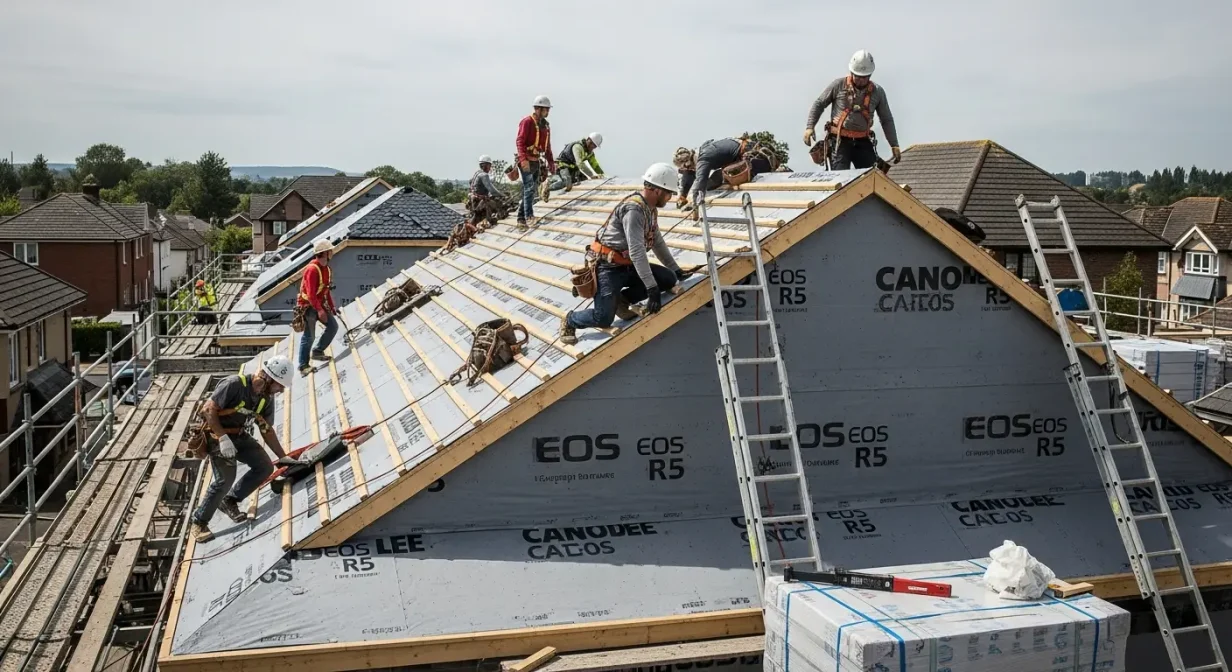
After more than eight years installing, inspecting, and repairing roofs across Dallas and North Texas, we at DeckingHub have worked with virtually every roof decking material available in today’s market. We’ve seen how material selection directly impacts long-term performance, especially in our challenging Texas climate where extreme heat, severe storms, and dramatic humidity fluctuations test every component of a roofing system.
Choosing the right roof decking materials represents one of the most critical decisions in any roofing project, yet it’s often overlooked by property owners who focus primarily on visible roofing materials. The roof decking forms the structural foundation that supports everything above it. It must withstand environmental stresses, hold fasteners securely through decades of service, resist moisture intrusion, and provide a stable platform for roofing materials.
Through hundreds of installations and countless repairs, we’ve learned which roof decking materials perform best in specific applications, which offer the best value for different budgets, and which problems commonly arise with various material choices. This comprehensive guide shares our field-tested knowledge to help you select the optimal decking material for your project.
Understanding Roof Decking Material Requirements
Roof decking materials serve multiple critical functions that determine overall roofing system performance. The primary structural function involves spanning between framing members while supporting dead loads (roofing materials) and live loads (workers, equipment, snow). The material must provide adequate fastener withdrawal resistance to keep roofing materials secure during wind events, which is particularly important in Dallas where severe storms regularly occur.
Beyond structural performance, roof sheathing must resist moisture from both above (rain penetration through compromised roofing) and below (condensation in poorly ventilated attics). Dimensional stability matters because materials that swell excessively when wet can create ridges that telegraph through roofing materials. Fire resistance requirements vary by building code and location, though most residential applications permit wood-based products with appropriate fire-rated roofing assemblies.
Key Performance Requirements:
| Requirement | Why It Matters | Impact on Material Selection |
|---|---|---|
| Structural Capacity | Prevents sagging and failure | Determines thickness and span ratings |
| Fastener Holding | Keeps roofing secure in wind | Affects density and composition |
| Moisture Resistance | Prevents rot and deterioration | Influences wood species or coating |
| Dimensional Stability | Avoids telegraphing and buckling | Impacts manufacturing process |
| Fire Rating | Code compliance and safety | May require specific materials |
Understanding these requirements helps explain why certain materials excel in specific applications while performing poorly in others. The best roof decking materials for your project depend on balancing these factors against budget constraints and installation requirements.
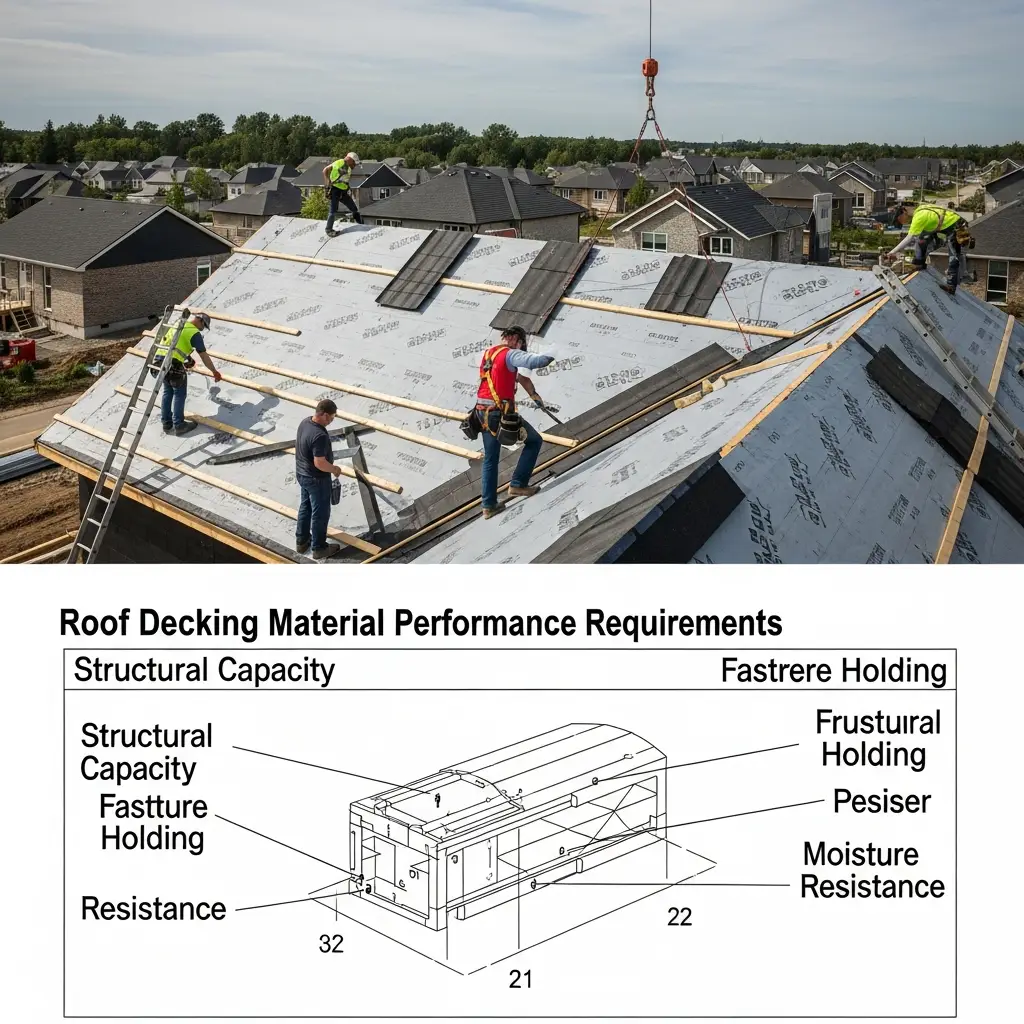
Ensuring proper roof decking installation is crucial for structural integrity and prevents premature failure. Check local building codes for required thickness and fastening schedules.
Wood-Based Roof Decking Materials
Wood-based products dominate residential roof decking in Dallas and throughout North Texas. These materials offer excellent strength-to-weight ratios, proven long-term performance, and compatibility with standard roofing practices at competitive prices.
Oriented Strand Board (OSB)
OSB roof decking has become the most common choice for residential construction over the past three decades. Manufactured from wood strands oriented in specific directions and bonded with resin under heat and pressure, OSB provides consistent performance without the voids or weak spots sometimes found in lower-grade plywood.
OSB Advantages:
- Costs 15-30% less than comparable plywood
- Uniform composition throughout each panel
- No voids or gaps that weaken structure
- Consistent quality from modern manufacturing
- Readily available in all standard sizes
OSB Considerations:
- Swells more than plywood when exposed to moisture
- Edge swelling can telegraph through shingles
- Requires prompt weather protection during installation
- Early generations had durability issues (largely resolved in current products)
We’ve installed thousands of squares of OSB on Dallas residential projects with excellent results. Modern enhanced OSB products with improved moisture resistance and edge sealing perform nearly as well as plywood in wet conditions while maintaining significant cost advantages. For homeowners considering OSB versus radiant barrier products, radiant barrier decking uses OSB as the base with reflective foil facing that can reduce attic temperatures by 20-30°F during Dallas summers.
Plywood
Plywood consists of thin wood veneers glued together with alternating grain directions, creating exceptional dimensional stability and moisture resistance. This traditional roof decking material has served reliably for generations and remains the premium choice when budget allows.
The best wood for roof decking in plywood form typically uses southern pine or Douglas fir veneers with exterior-grade adhesives. CDX plywood (Construction grade, D-grade inner plies, eXterior glue) represents the standard for roof sheathing, though better grades offer improved appearance and fewer voids.
Plywood Advantages:
- Superior moisture resistance compared to standard OSB
- Better dimensional stability during wetting/drying cycles
- Proven longevity exceeding 50 years when properly maintained
- Less edge swelling when exposed to moisture
- Easier to cut and handle on job sites
Plywood Considerations:
- Costs 20-40% more than comparable OSB
- Quality varies significantly between grades
- Lower grades may contain voids reducing strength
- Can delaminate if exposed to prolonged moisture
We typically recommend plywood for projects in exposed areas, complex roof geometries where water might pond, or when homeowners prioritize maximum performance regardless of cost. The superior aging characteristics we’ve observed on older roofs justify the premium for many clients.
Board Sheathing
Traditional board sheathing using dimensional lumber (1×6, 1×8, or 1×12 boards) has largely been replaced by panel products but still appears on historic homes and some specialty applications. We occasionally work with board sheathing during renovation projects on older Dallas homes.
Board sheathing offers natural ventilation between boards and creates a distinctive appearance under certain roofing materials. However, it requires more labor to install, provides less structural rigidity than panels, and can allow water penetration between boards if roofing fails.

OSB decking offers a cost-effective roofing solution. Ensure proper nail spacing and immediate weather protection to prevent moisture damage and swelling.
Metal Roof Decking Materials
Metal decking dominates commercial and industrial construction while appearing occasionally in upscale residential applications. Understanding the various types of metal roof decking helps recognize when these materials make sense.
B-Deck and N-Deck Profiles
B-deck metal panels feature 1.5-inch deep corrugations and represent the most economical metal decking option for commercial applications. We’ve installed B-deck on warehouses, retail centers, and office buildings throughout Dallas. The material spans longer distances than wood products, reducing framing costs while providing non-combustible construction.
N-deck uses deeper 3-inch corrugations for even longer spans and heavier load applications. Both profiles come in various gauges (22, 20, 18, 16) with thicker gauges providing greater strength and spanning capability.
Metal Decking Advantages:
- Non-combustible construction meeting stringent fire codes
- Longer spanning capability reduces framing costs
- Doesn’t rot or deteriorate from moisture
- Lighter weight than concrete alternatives
- Stable dimensions regardless of humidity
Metal Decking Considerations:
- Requires specialized installation skills and equipment
- More expensive than wood products for residential scale
- Needs proper coating maintenance to prevent corrosion
- Thermal conductivity requires careful insulation design
- Penetrations and fasteners create potential leak points
Metal deck typically gets installed over structural steel framing, welded or mechanically fastened according to engineering specifications. Proper installation requires understanding load tables, fastening patterns, and coordination with roofing membrane or metal panel systems installed above.
Standing Seam Considerations
When installing standing seam metal roof systems, the decking requirements differ from shingle applications. Metal roofing’s dimensional stability and spanning capability can sometimes allow wider framing spacing, but the decking must accommodate clip fastening systems and thermal movement. We’ve completed several projects where solid wood decking supported standing seam installations, providing excellent long-term performance.

Metal decking provides a non-combustible, long-span solution for commercial roofing. Proper fastening ensures structural integrity and long-term performance. Consider gauge thickness for load requirements.
Specialty Roof Decking Materials
Beyond standard wood and metal options, certain applications warrant specialized roof decking materials that offer specific performance advantages.
Concrete Roof Decking
Reinforced concrete roof deck provides unmatched fire resistance, sound isolation, and structural capacity. While we don’t frequently work with concrete decking in residential applications, we’ve been involved in commercial projects where building codes, insurance requirements, or performance needs mandated concrete construction.
Concrete decking excels in parking structures, high-rise buildings, and facilities requiring maximum fire ratings. Installation costs significantly exceed wood or metal alternatives—typically $8-15 per square foot installed—but lifecycle costs may be competitive when factoring in durability and minimal maintenance requirements over 75-100 year service lives.
Structural Insulated Panels
Some modern construction uses structural insulated panels (SIPs) that combine insulation with structural decking in a single component. These panels provide exceptional energy efficiency and faster installation but require specialized knowledge and aren’t widely available in all markets.
Tongue and Groove Decking
Specialty applications sometimes use tongue and groove lumber that creates finished ceiling appearance from below while serving as structural decking. We’ve installed this material on covered porches and other areas where the underside remains visible, combining structural function with aesthetic appeal.

Concrete roof decks offer superior fire resistance and longevity for commercial buildings. Though costly upfront, their minimal maintenance yields long-term savings.
Selecting the Best Roof Decking Sheet Materials
Choosing the best roof decking sheet for your specific project requires evaluating multiple factors beyond just material type. Panel thickness, span rating, edge configuration, and coating options all influence final performance and cost.
Standard Panel Sizes and Ratings:
| Panel Size | Common Span Ratings | Typical Applications | Coverage |
|---|---|---|---|
| 4′ x 8′ | 24/16, 32/16, 40/20, 48/24 | Residential roofing | 32 sq ft |
| 4′ x 9′ | Same as above | Reduces waste on some layouts | 36 sq ft |
| 4′ x 10′ | Same as above | Commercial applications | 40 sq ft |
The span rating indicates maximum support spacing—the first number for roof applications, the second for floor applications. A 32/16 panel can span 32 inches between supports when used for roofing. We verify that selected panels meet or exceed span ratings for actual framing spacing on every project.
Thickness Selection
Panel thickness directly impacts structural performance, cost, and installation requirements. The International Residential Code establishes minimums based on framing spacing, but we often exceed these minimums based on our Dallas experience.
For standard residential construction with 24-inch rafter spacing, we recommend minimum 1/2-inch OSB or 15/32-inch plywood as practical minimums that perform well long-term. When installing heavy roofing materials like tile or slate, or when framing spacing exceeds 24 inches, thickness requirements increase accordingly.
Edge Configurations
Panels come with square edges, tongue-and-groove edges, or are designed for use with roof deck clips (H-clips) that support edges between framing members. The IRC requires edge support when panel edges fall between supports. We use H-clips on most residential projects as they provide necessary support without requiring additional blocking labor.
Tongue-and-groove panels eliminate clip requirements by providing integrated edge support, but they cost 15-25% more than square-edge panels. For premium projects or when installing heavy roofing materials, the additional cost may be justified.

Selecting the correct roof decking thickness ensures structural integrity and code compliance. Consult a professional for optimal panel selection and span rating.
Installation Materials and Fasteners
Proper installation of roof decking materials requires appropriate fasteners and accessories that ensure secure attachment and long-term performance.
Roof Decking Nails
Roof decking nails must provide adequate withdrawal resistance while driving flush without overdriving. We use 8d ring-shank nails (2-3/8 inches long) for standard residential installations, as the ring shanks provide superior holding compared to smooth-shank nails.
Fastening schedules specify nail spacing at panel edges (typically 6 inches on center) and in panel field areas (typically 12 inches on center). In high-wind areas or when installing heavy roofing materials, we decrease spacing to 6 inches throughout or switch to screws for even better holding power.
Fastener Requirements:
- Panel edges: 6″ spacing with ring-shank nails
- Panel field: 12″ spacing standard, 6″ for high-wind areas
- Penetration: Must extend minimum 3/4″ into framing
- Overdriving: Flush without crushing wood fibers
Pneumatic nail guns make installation efficient, but they must be properly adjusted to avoid overdriving that crushes wood and reduces holding capacity by up to 50%.
Supporting Accessories
Beyond primary fasteners, several accessories enhance installation quality. H-clips support panel edges between framing members, preventing excessive deflection that could crack brittle roofing materials. Roof boots seal vent pipe penetrations, while proper flashing at the roof ridge prevents water intrusion at vulnerable transitions.
Roof trim installation at eaves and rakes protects decking edges while providing finished appearance. We pay particular attention to these details because they significantly impact long-term performance and appearance.
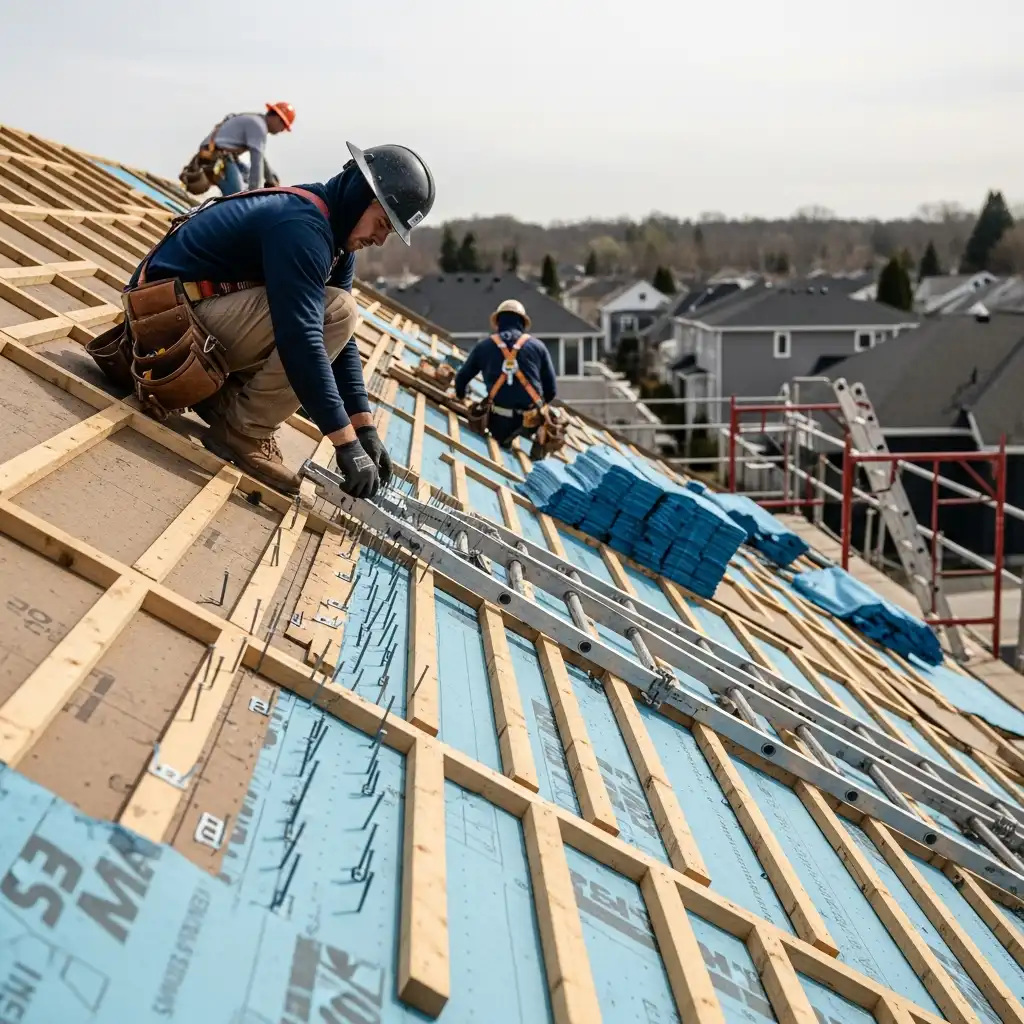
Using properly spaced ring-shank nails ensures secure roof decking, preventing nail pull-out and costly roof failures in high winds.
Cost Analysis for Dallas Market
Understanding the roof sheathing labor cost and material expenses helps property owners budget appropriately for roof decking projects.
Material Costs (Per Sheet, Dallas Market):
| Material Type | Standard Grade | Premium/Enhanced |
|---|---|---|
| 7/16″ OSB | $12-18 | $18-26 |
| 1/2″ OSB | $15-21 | $21-29 |
| 15/32″ Plywood | $23-33 | $30-42 |
| 5/8″ Plywood | $29-41 | $38-52 |
| Radiant Barrier | N/A | $28-38 |
These prices fluctuate with lumber markets, so current quotes are essential. Material costs represent only part of total project expense, as labor typically equals or exceeds material costs.
Labor Costs:
Straightforward installations on accessible roofs with simple geometry might cost $2.50-4.00 per square foot for labor. Complex roofs with multiple valleys, steep pitches, or difficult access could reach $5-8 per square foot. Factors influencing labor costs include roof pitch and accessibility, complexity of roof geometry, height of building, weather protection requirements, and disposal of old materials when replacing existing decking.
For projects like building a porch roof or adding a gable roof over patio, decking costs scale with project size but often show higher per-square-foot pricing due to mobilization costs.

Roof decking costs in Dallas fluctuate; factor in complexity & accessibility for accurate quotes. Proper sheathing is crucial for roof integrity & weather resistance.
Climate Considerations for Dallas Installations
Dallas’s climate significantly influences roof decking material selection and installation practices. Summer temperatures regularly exceed 100°F with roof surface temperatures reaching 160°F or higher. Winter occasionally brings freezing conditions, while spring and fall can be quite humid. This temperature and moisture cycling stresses all materials.
Climate-Specific Recommendations:
Wood-based products handle Dallas conditions well when properly installed and protected. OSB performs adequately with prompt weather protection during installation. Enhanced OSB or plywood provides additional security for homeowners concerned about moisture exposure. Radiant barrier products reduce attic temperatures substantially, extending life of all roofing components while reducing cooling costs.
Metal decking handles thermal cycling without moisture-related concerns, though thermal expansion must be accommodated in fastening design. Proper coating maintenance prevents corrosion in our occasionally humid climate.
We’ve assessed numerous cases of roof storm damage where inadequate decking contributed to failures during severe weather. Proper fastening and appropriate thickness selection provide security during high-wind events that regularly affect North Texas.

Radiant barrier sheathing lowers attic temperatures and reduces cooling costs. Compliant installation protects decking from heat stress per Dallas building codes.
Common Mistakes to Avoid
Through years of installing and repairing roof decking, we’ve encountered recurring mistakes that compromise performance and longevity.
Critical Errors:
Using inadequate thickness to save money creates long-term problems that far exceed the minimal material savings. We’ve corrected numerous installations where thin decking sagged between rafters or failed to hold fasteners properly during wind events.
Allowing panels to get wet during construction causes edge swelling and delamination, particularly with OSB. We protect installed decking immediately, covering sections the same day whenever possible and always before weather threatens.
Installing panels without proper spacing creates buckling when materials expand. The required 1/8-inch gaps between panel ends and 1/16-inch gaps along edges seem minor but prevent significant problems.
Omitting edge support allows excessive deflection that can crack roofing materials above. H-clips or blocking are essential, not optional.
Incorrect fastening—whether missing fasteners, wrong sizes, improper spacing, or overdriving—compromises the entire system. We’ve traced numerous shingle blow-offs directly to inadequate decking fastening.
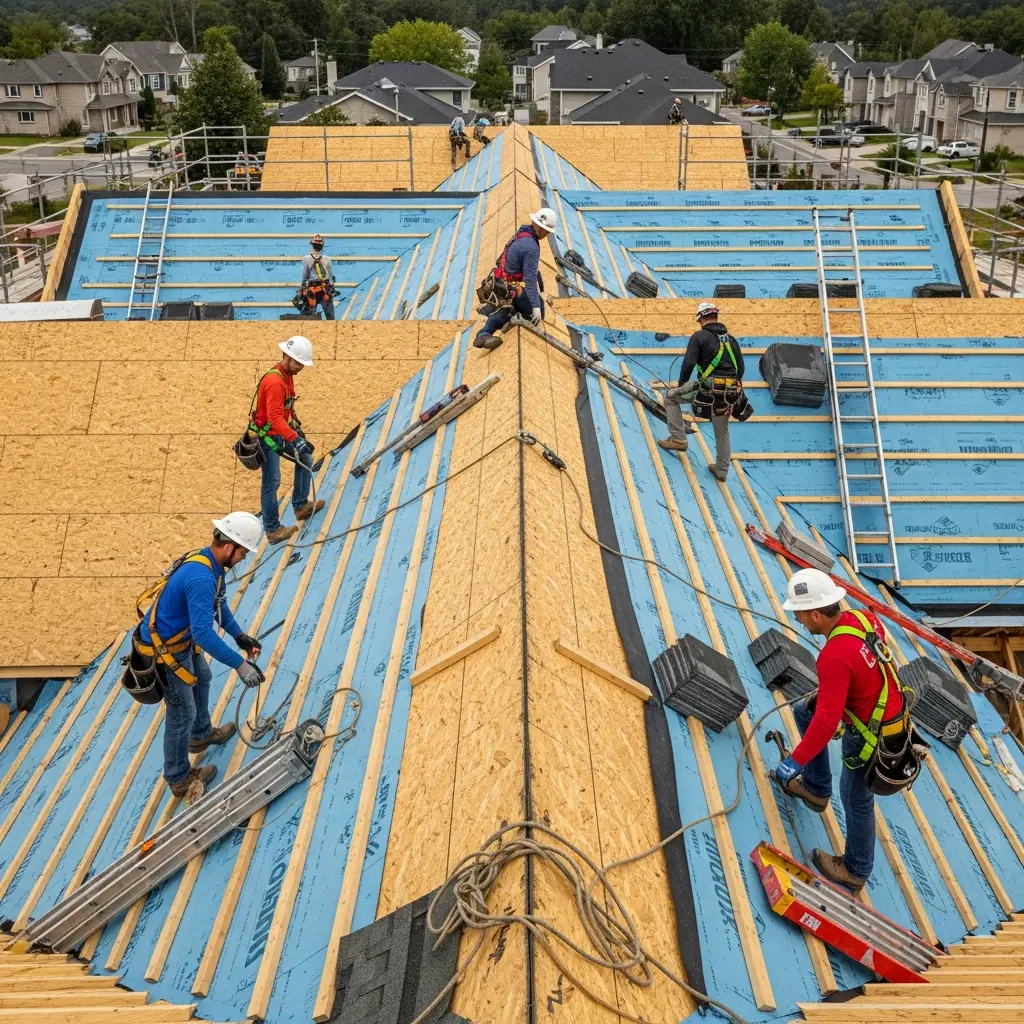
Correct roof decking installation is crucial for a durable, long-lasting roof. Ensure proper spacing, fastening, and weather protection to prevent costly repairs later.
Building Code Compliance
Roof decking materials must comply with International Residential Code (IRC) and International Building Code (IBC) requirements as adopted by local jurisdictions. Section R803 of the IRC establishes minimum requirements for roof sheathing including minimum thicknesses based on framing spacing, allowable span ratings for different materials, and fastening schedules for various applications.
We reference these requirements on every project but frequently exceed minimums based on our experience with long-term performance in Dallas conditions. Code compliance represents the floor, not the ceiling, of what we recommend for quality installations.
Most roof decking work requires building permits and inspections. Complete roof replacement including decking definitely requires permits, while minor repairs might not depending on scope and local requirements. We always verify permit requirements with local building departments before starting work.
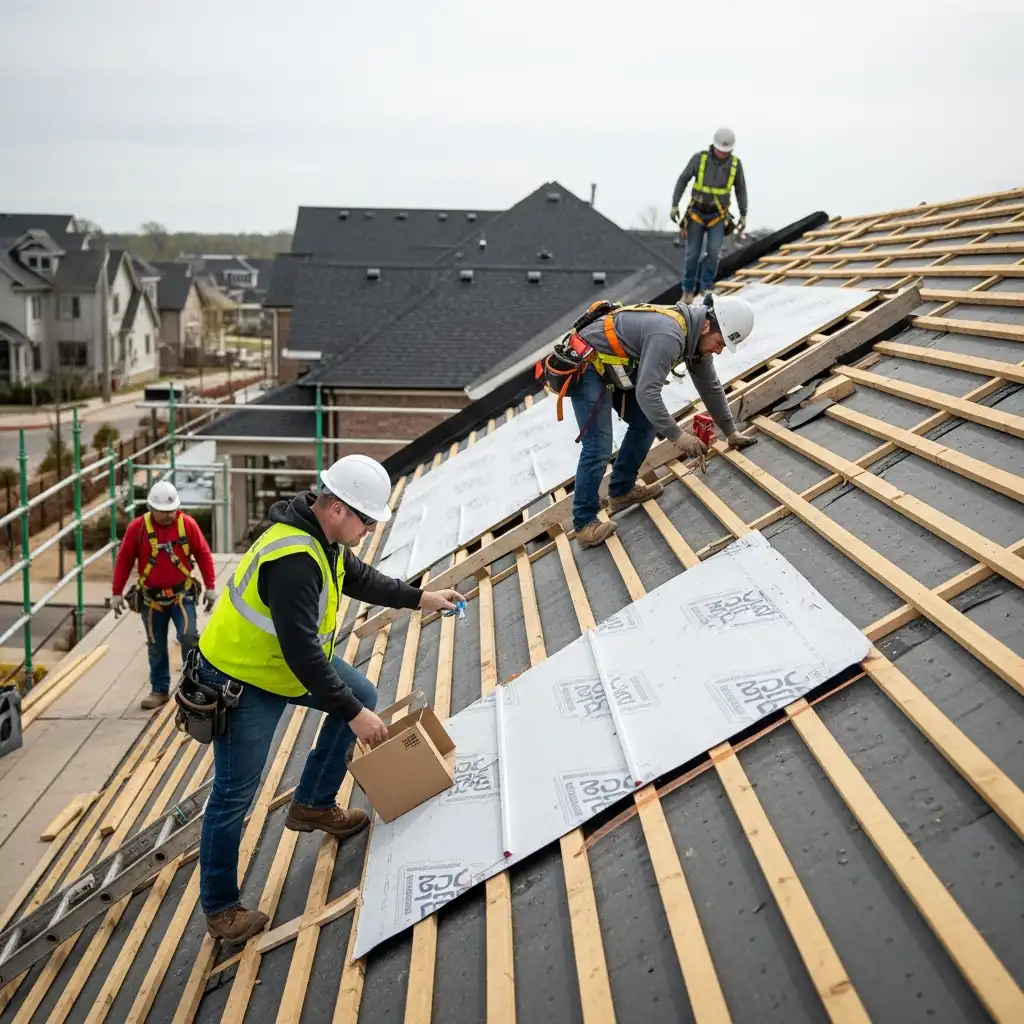
Roof decking must meet IRC/IBC standards. We often exceed minimums for lasting Dallas performance, ensuring code compliance and quality installations.
Maintenance and Longevity
Properly installed roof decking materials require minimal maintenance but benefit from periodic inspection. We recommend annual checks from the attic, looking for water stains on decking underside, sagging between rafters, daylight visible through gaps or holes, signs of mold or deterioration, and adequate ventilation to prevent moisture buildup.
Maintaining the roofing materials above the decking provides primary protection. Prompt repair of damaged fiberglass shingles, luxury asphalt shingles, or impact resistant shingles prevents water intrusion that damages decking. Similarly, maintaining metal roof sealant and ensuring proper function of box vent roof systems protects underlying structure.
When damage occurs requiring emergency roof tarp installation, we assess decking condition and replace any compromised sections before installing permanent repairs. Even temporary fixes must address underlying structural issues to prevent progressive damage.
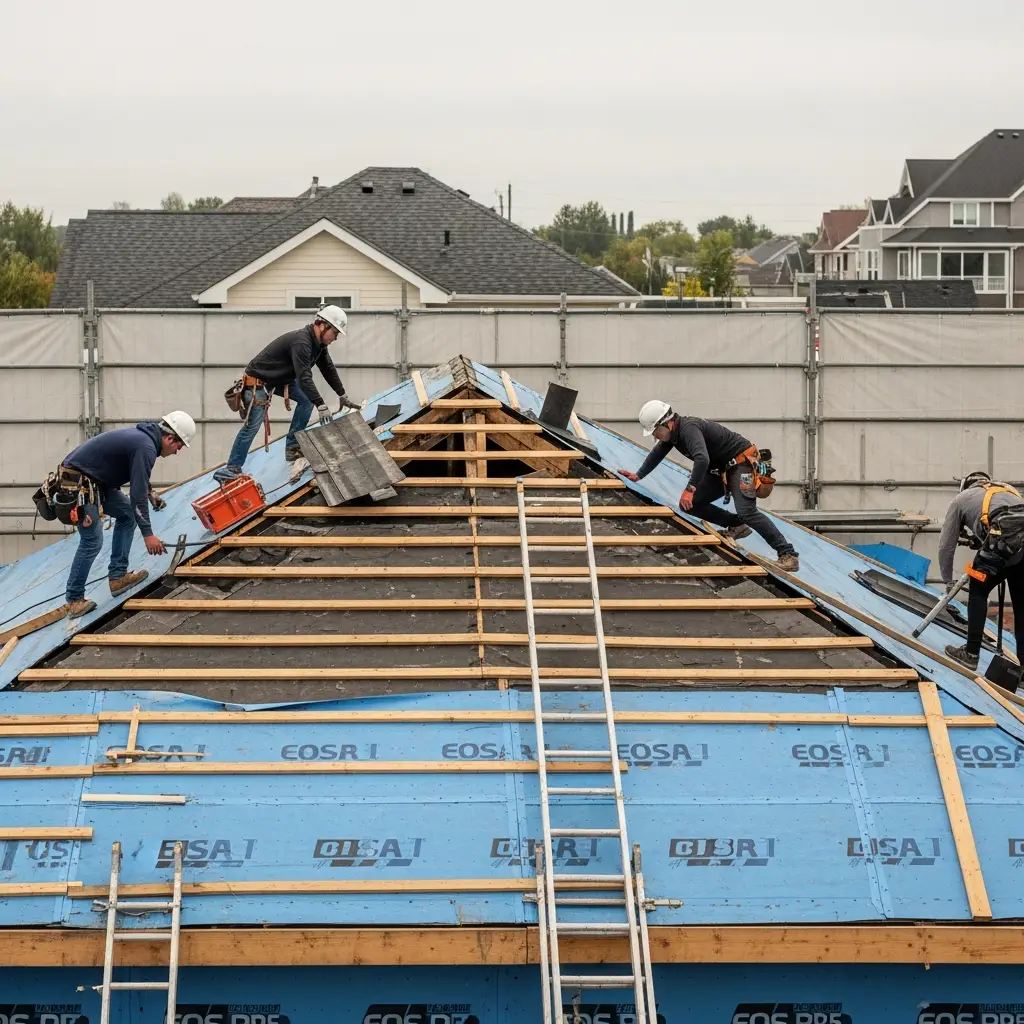
Regular roof inspections catch minor shingle damage early, preventing costly water damage and extending the life of your roofing system.
Conclusion
Selecting appropriate roof decking materials requires balancing performance requirements, budget constraints, and long-term value considerations. Through more than eight years of hands-on experience across Dallas, we’ve learned that investing in quality materials and proper installation provides decades of reliable service while false economy on this critical component leads to expensive problems.
For most Dallas residential applications, we recommend 1/2-inch OSB or 15/32-inch plywood as practical minimums that perform well long-term. Enhanced OSB products or premium plywood justify their additional cost in challenging installations or when maximum longevity is prioritized. Radiant barrier products provide measurable energy savings that typically justify their premium within 5-7 years in our hot climate.
Commercial applications often warrant metal decking that provides longer spanning capability, non-combustible construction, and excellent long-term durability. The higher initial cost becomes reasonable when evaluated against lifecycle performance and reduced maintenance requirements.
Regardless of material selection, proper installation using appropriate fasteners, correct spacing, adequate edge support, and prompt weather protection ensures optimal performance. Working with experienced professionals who understand material characteristics, local climate challenges, and building code requirements provides confidence that your roof decking will support reliable roofing system performance for decades to come.
Frequently Asked Questions
What is the best roof decking material for Dallas homes?
For most Dallas residential applications, 1/2-inch OSB or 15/32-inch plywood provides excellent performance at reasonable cost. OSB costs less while plywood offers superior moisture resistance. Radiant barrier OSB reduces cooling costs significantly in our hot climate.
How long do different roof decking materials last?
Properly installed OSB or plywood in well-ventilated attics typically lasts 40-50+ years. Metal decking can last 50-75 years with proper coating maintenance. Concrete decking often exceeds 75-100 years. Actual lifespan depends on installation quality, ventilation, and whether leaks occur.
Can I use different thicknesses of decking on the same roof?
Avoid mixing panel thicknesses on the same roof plane as this creates uneven surfaces that telegraph through roofing materials. When replacing damaged sections, match existing thickness. For complete re-decking, use consistent material throughout each continuous roof section.
What’s the difference between OSB and plywood for roofing?
OSB costs 15-30% less and has uniform composition throughout. Plywood offers better moisture resistance and dimensional stability. Both perform well when properly installed. We use OSB for most projects, recommending plywood for exposed areas or when budget allows.
Do I need special fasteners for roof decking?
Use 8d ring-shank nails (2-3/8″ long) for standard installations. Ring shanks provide superior holding compared to smooth nails. Space fasteners 6″ on center at panel edges and 12″ in field areas. High-wind areas may require closer spacing or screws.
Should I use H-clips when installing roof decking?
Yes, when panel edges fall between framing members. H-clips prevent excessive edge deflection that can crack roofing materials. The IRC requires edge support through clips, blocking, or tongue-and-groove panels. We use H-clips on most residential projects for cost-effective edge support.
How much does roof decking material cost in Dallas?
Standard 1/2″ OSB runs $15-21 per sheet, while 15/32″ plywood costs $23-33 per sheet. Labor typically equals or exceeds material costs at $2.50-8.00 per square foot depending on complexity. Complete decking replacement on average homes runs $6,000-15,000 including labor and materials.
Can metal roof decking be used on residential homes?
Yes, though it’s more common in commercial applications. Metal decking provides longer spans, non-combustible construction, and excellent durability. The higher cost and specialized installation requirements make it less common for standard residential projects, though it appears in upscale custom homes and specific applications.
