
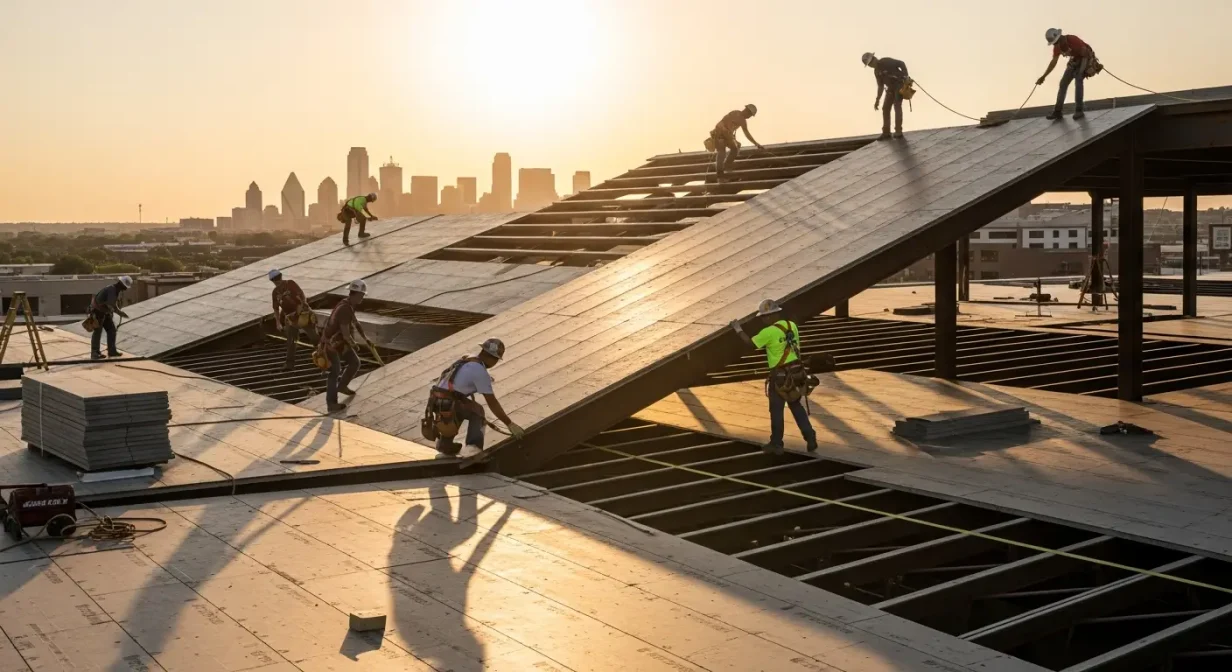
Contractor’s Bottom Line
Types of metal roof decking are categorized by their rib profile and structural load-bearing capacity for commercial construction. The most common is 1.5-inch B-deck, which provides optimal strength-to-weight ratio for standard roofing spans, while N-deck offers deeper ribs for longer unsupported spans. Select the deck profile based on the structural engineer’s specified span capabilities and the required fire rating assembly.
Key Takeaways
- Structural B-Decking is the industry standard for spans up to 10 feet, requiring ASTM A653 G-90 galvanized coating for corrosion resistance.
- IRC R905 requires specific fastener patterns for metal decks to meet wind uplift ratings in North Texas high-wind zones.
- Metal decking provides superior fire resistance compared to OSB or CDX plywood, often lowering commercial insurance premiums in Dallas.
After eight years as a construction consultant in the Dallas-Fort Worth area, I have seen how critical the choice of decking is for long-term roof integrity. Many property owners confuse the visible metal roofing panels with the structural metal decking underneath, leading to significant specification errors during the design phase. In the North Texas climate, where temperatures swing 40 degrees in a single day, the thermal expansion of steel requires precise engineering and material selection. FIELD NOTE #1: During a recent inspection in a Dallas neighborhood, I found a contractor using thin-gauge residential panels as structural decking on a commercial-to-residential conversion.
The deck failed to meet the span requirements of IRC 2021, resulting in a code violation that cost the owner $18,000 to remediate before the project could proceed. We eventually specified 22-gauge B-decking to ensure the structure could support the weight of architectural shingles and potential snow loads. Understanding the differences between B-deck, N-deck, and composite decking is essential for any major project in the DFW Metroplex. The National Roofing Contractors Association (NRCA) emphasizes that the substrate is the foundation of the entire roofing assembly.
Choosing the wrong gauge or profile can lead to structural sagging or even catastrophic failure during a North Texas hail storm.
Anatomy of Structural Metal Decking
Structural metal roof decking is primarily manufactured from cold-rolled carbon steel sheet, which is then coated for protection against the elements. The most common coating for Dallas projects is G-90 galvanized steel, which provides 0.90 ounces of zinc per square foot according to ASTM A653 standards. This coating is vital for resisting the high humidity and moisture levels often trapped in attic spaces between the deck and the synthetic underlayment. While wood-based products like OSB (oriented strand board) and CDX plywood are common in residential roofing, metal decking offers a non-combustible alternative.
The manufacturing process involves roll-forming the steel into specific profiles that increase the material’s moment of inertia and load-bearing capacity. This allows for much wider spans between steel joists than traditional 15/32-inch CDX plywood or Advantech panels could ever achieve. In addition to galvanized steel, some specialty applications in the DFW Metroplex utilize aluminum or stainless steel decking for extreme corrosion resistance. However, for 95% of North Texas commercial builds, G-90 galvanized steel remains the gold standard.
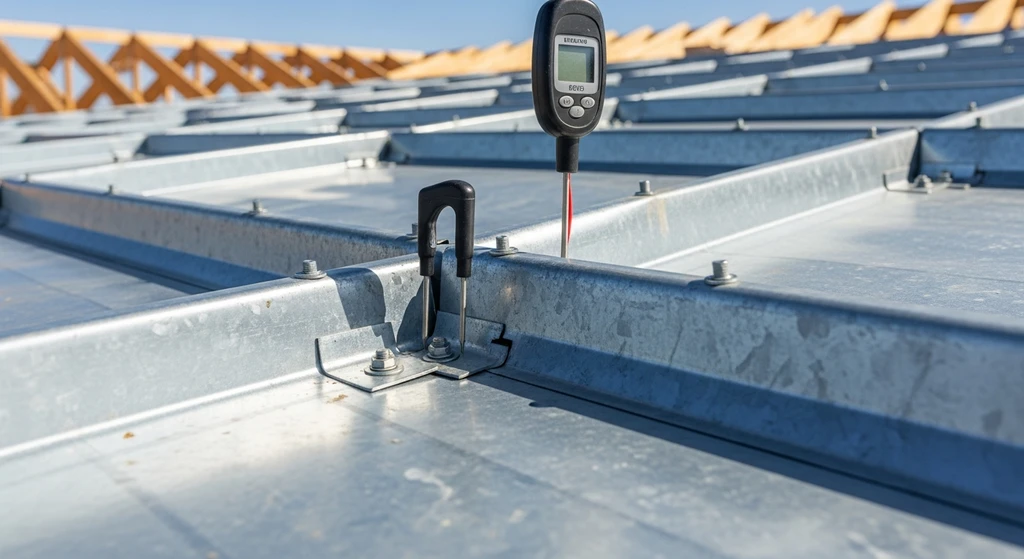
Citing ASTM D1761, we must also ensure that all mechanical fasteners used to secure the decking are compatible with the coating to prevent galvanic corrosion.
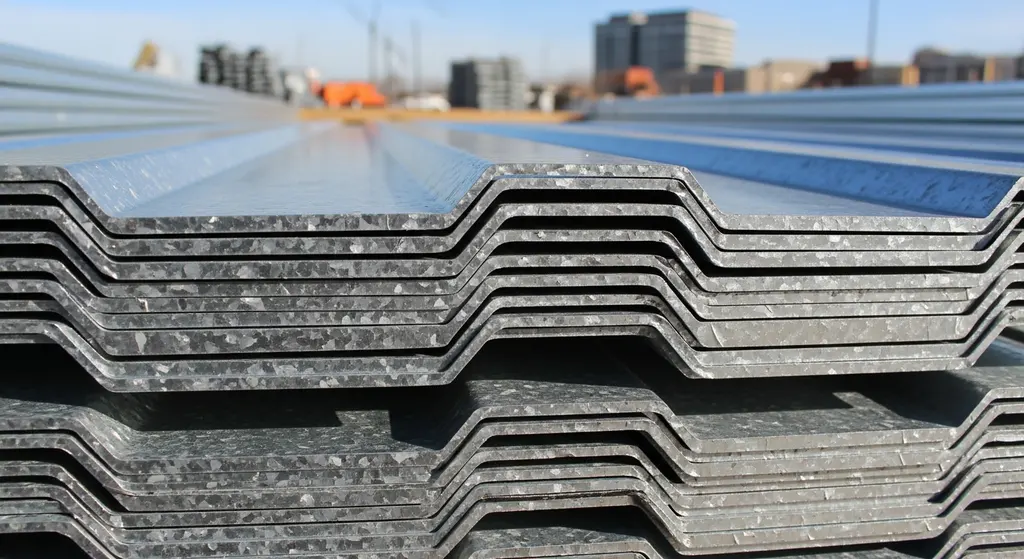
| Common Metal Deck Gauges | |
|---|---|
| 22 Gauge | Standard commercial duty (.0295 inches) |
| 20 Gauge | Heavy duty for longer spans (.0358 inches) |
| 18 Gauge | Extra heavy duty structural (.0474 inches) |
Choosing the Right Profile: B-Deck vs. N-Deck
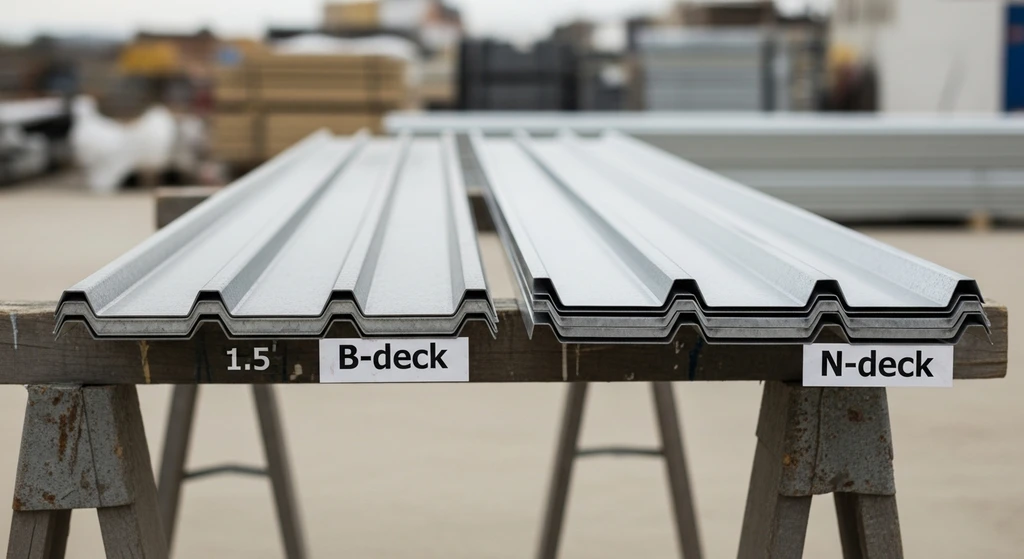
The profile of the metal decking determines its structural performance and how much weight it can support over a given span. Type B (Wide Rib) decking is the most common variety found in Dallas-Fort Worth commercial construction, typically measuring 1.5 inches deep. It provides an excellent balance of strength and cost-efficiency for spans ranging from 4 to 10 feet between supports. For projects requiring even longer spans or heavier loads, such as those supporting heavy green roof assemblies or large HVAC units, Type N (Deep Rib) decking is the preferred choice.
N-decking is typically 3 inches deep and offers significantly higher stiffness. When installing architectural shingles or 3-tab shingles over these decks, a layer of rigid insulation and a wood nailer or specialized synthetic underlayment is required to meet IRC R905 requirements. In some specialized Dallas builds, we see composite metal decking used where a concrete slab is poured over the metal. This is common in multi-story residential buildings in the DFW Metroplex where fire ratings and floor-to-floor sound attenuation are priorities.
Regardless of the profile, the National Roofing Contractors Association (NRCA) recommends verifying that the deck is clean, dry, and free of oil before any underlayment or insulation is applied.
Advantages
- Non-combustible material (Class A Fire Rating)
- High strength-to-weight ratio compared to OSB
- Longer span capabilities for open-ceiling designs
Disadvantages
- Higher initial material cost than CDX plywood
- Requires specialized tools and labor for installation
- Prone to thermal expansion noise if not fastened correctly
Field Note from Experience
Last month, a Dallas homeowner called me after their ‘budget’ contractor installed 24-gauge decking on a 7-foot span. The deck began to deflect under the weight of new architectural shingles, causing visible sagging in the ceiling. We had to reinforce the entire structure from below, which cost the owner $12,500—nearly double what they thought they saved on the cheaper material.
Performance in the North Texas Environment
The Dallas-Fort Worth climate presents unique challenges for metal decking, primarily due to extreme heat and rapid temperature fluctuations. During a typical Texas summer, roof surface temperatures can exceed 160 degrees Fahrenheit. This causes significant thermal expansion in steel decking, which can stress fasteners and underlayment if not properly accounted for in the design. We often see ASTM D226 felt underlayment fail under these conditions, which is why I recommend a high-quality synthetic underlayment.
Hail is another major factor in the DFW Metroplex. While the metal decking itself is rarely compromised by hail, the roofing material above it (such as asphalt shingles) can be. A rigid metal deck provides a solid substrate that prevents ‘dimpling’ or structural punctures during severe storms. This is a significant advantage over oriented strand board (OSB), which can soften over time if moisture penetrates the shingles.
Furthermore, the International Code Council (ICC) standards adopted in Dallas require specific wind uplift resistance. Metal decking, when fastened according to IRC R803.2.1, provides superior resistance to the straight-line winds and microbursts common in North Texas. I always advise clients to ensure their decking meets Energy Star requirements for reflectivity if the deck is left exposed in a ‘cool roof’ commercial application.
Visible rust on new panels
Consequence: Indicates a failure in the G-90 galvanization process; will lead to structural failure within 5-10 years.
Mixing different metal types
Consequence: Galvanic corrosion will occur, eating through the fasteners and causing the deck to detach.
What Contractors Hide: The Truth About Metal Decking
In the Dallas roofing market, transparency is often lacking when it comes to material specifications. One of the most common ‘tricks’ is substituting a thinner gauge of steel than what was quoted. For example, a contractor might quote 22-gauge decking but install 24-gauge, which is significantly weaker. Since the difference is only a few thousandths of an inch, most homeowners will never notice until the deck begins to sag under a heavy load.
Another common practice is the reuse of old flashing or skipping the installation of an ice and water shield in critical valleys. While Texas code (IRC R905) is less stringent on ice barriers than northern states, the NRCA still recommends them for high-end metal systems to prevent leaks from wind-driven rain. Contractors often skip these ‘invisible’ layers to pad their profit margins, which can be as high as 40% on metal roofing projects. Finally, many contractors will not mention that the warranty on metal decking is often voided if it is not stored properly on-site.
If panels are left in standing water or stacked without ventilation before installation, they can develop ‘white rust,’ which is a premature oxidation of the zinc coating. Always demand to see the ASTM International certification tags on the material bundles delivered to your DFW Metroplex property.
Dallas Market Pricing
In Dallas-Fort Worth, expect to pay $4.50-$7.50 per square foot for structural metal decking. These are current 2026 Dallas market prices; costs vary by region and can be 15-25% higher in remote Texas areas. Peak pricing occurs during the spring (March-May) storm season due to high demand.
What Contractors Hide
Gauge Substitution
The Reality: Contractors save 15-20% on material costs by using thinner steel, compromising structural integrity.
Skipping Synthetic Underlayment
The Reality: Standard felt is used instead of synthetic to save $0.50 per square foot, leading to faster degradation.
External Authoritative Resources
These industry-standard references support the information in this guide:
Building Codes
Frequently Asked Questions
Can I install metal decking over existing wood decking?
While possible, it is not recommended as it traps moisture between layers; NRCA standards suggest a full tear-off to inspect the underlying structure.
What is the best gauge for a residential metal roof in Dallas?
For structural applications, 22-gauge is the standard; for decorative panels over wood, 24-gauge or 26-gauge is common per ASTM A653.
Does metal decking require a specific underlayment?
Yes, I recommend a high-temp synthetic underlayment meeting ASTM D226 Type II to handle the extreme heat of the DFW Metroplex.
Is metal decking louder during rain than plywood?
If properly insulated with rigid foam and a solid ceiling assembly, the decibel difference is negligible compared to OSB or CDX plywood.
Does metal decking interfere with Wi-Fi or cell signals?
In some cases, it can act as a Faraday cage; however, modern DFW homes use internal repeaters to solve any signal attenuation issues.
How long does G-90 galvanized decking last?
When installed correctly and protected by a quality roof system, structural metal decking can last 50+ years in the Texas climate.
Final Thoughts
Selecting the right type of metal roof decking is a technical decision that impacts the safety and longevity of your entire building. In the Dallas-Fort Worth area, the combination of high winds, intense heat, and hail makes structural integrity non-negotiable. By adhering to NRCA guidelines and insisting on ASTM-rated materials, you protect your investment from the common failures I see every day in the field. FIELD NOTE #3: I recently consulted on a project in Fort Worth where the owner insisted on a ‘free roof’ from a storm chaser.
The contractor used sub-standard 26-gauge decking that wasn’t G-90 rated. Two years later, the zinc coating failed, and the deck began to rust through from the inside out. Don’t fall for scams; hire a professional who understands the International Building Code and Texas climate challenges. Always prioritize quality over the lowest bid to ensure your roof stands the test of time.
