
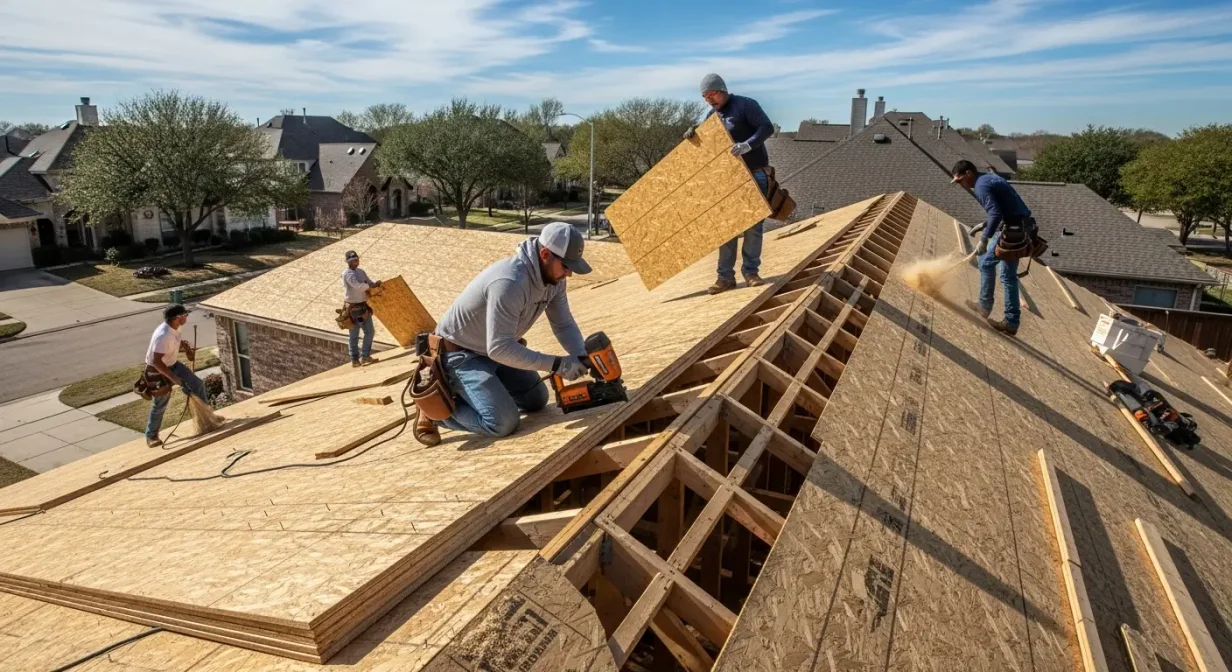
Contractor’s Bottom Line
For most residential projects in the Dallas-Fort Worth Metroplex, the standard roof decking nail size is an 8d common nail (2.5 inches). According to IRC R803.2.1, these must be spaced 6 inches on center at supported edges and 12 inches in the field. Using the wrong fastener or over-driving nails into OSB or CDX plywood can lead to catastrophic wind uplift failure during North Texas storms. Expect to pay between $1.75 and $2.50 per square foot for professional decking installation in the current 2026 Dallas market. Always ensure your contractor adheres to ASTM D1761 standards for mechanical fasteners to maintain your manufacturer warranty.
Key Takeaways
- The International Residential Code (IRC R803.2.1) mandates 8d nails for roof sheathing up to 1-inch thick.
- NRCA recommends ring-shank nails over smooth-shank for superior withdrawal resistance in high-wind zones like North Texas.
- ASTM D1761 standards govern the testing of these fasteners to ensure they handle the shear loads of asphalt shingles.
- Dallas building inspectors strictly enforce a 6-inch edge and 12-inch field nailing pattern for all new roof decking.
Installing roof decking is the most critical structural phase of a roofing project, especially given the extreme weather cycles we experience in the DFW Metroplex. As a consultant, I have seen many contractors try to speed up the process by using undersized staples or 6d nails, which simply do not provide the necessary shear strength for modern architectural shingles. FIELD NOTE #1: Last month, a Dallas homeowner called me after a spring storm ripped several sheets of OSB off their roof. The previous contractor had used 2-inch staples instead of code-compliant 8d nails, resulting in over $8,500 in interior water damage that insurance initially questioned.
We ultimately proved the installation violated IRC 2021 standards, but the stress on the family was entirely preventable. Understanding the relationship between fastener diameter, length, and the substrate—whether you are using oriented strand board (OSB) or CDX plywood—is vital for a long-lasting roof. This guide breaks down the specific technical requirements mandated by the International Code Council (ICC) and the National Roofing Contractors Association (NRCA).
IRC 2021 Requirements for Roof Sheathing Fasteners
The International Residential Code (IRC), specifically section IRC R803.2.1, provides the legal foundation for roof decking nail size. For sheathing thicknesses ranging from 7/16-inch to 1-inch, the code requires 8d common nails or 8d box nails. In the Dallas-Fort Worth area, local amendments often emphasize these requirements due to our classification in higher wind speed maps. Beyond the nail size itself, the IRC R905 section outlines how these fasteners must integrate with the underlayment and final roof covering.
It is not just about the length of the nail; the head diameter must be sufficient to prevent the sheathing from ‘pulling through’ during a wind event. We typically specify a minimum 0.113-inch shank diameter to meet these structural load-bearing requirements. Failure to follow these spacing and sizing rules can result in a failed inspection from the City of Dallas Building Inspection department. Many contractors overlook that IRC R803.2.1.1 specifically addresses the ‘blocking’ required at edges if the nailing pattern cannot be met.
Always verify that your installer is not ‘air-nailing’ into empty space between rafters.
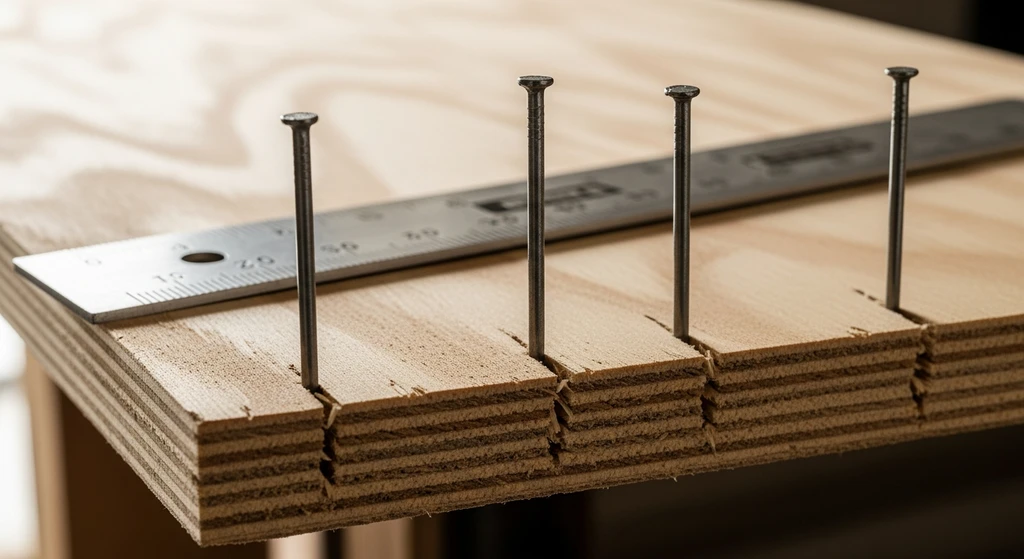
| Standard IRC Fastening Schedule | |
|---|---|
| Fastener Type | 8d Common Nail |
| Edge Spacing | 6 inches O.C. |
| Field Spacing | 12 inches O.C. |
ASTM D1761 and the Science of Withdrawal Resistance
Fasteners used in Texas roofing must comply with ASTM D1761, which tests the mechanical properties of wood fasteners. In the heat of a North Texas summer, wood structural panels like Advantech or standard OSB can expand and contract significantly. This ‘thermal cycling’ can cause smooth-shank nails to gradually back out, a phenomenon known as ‘nail back.’ To combat this, the National Roofing Contractors Association (NRCA) often suggests using ring-shank nails, even if code only requires ‘common’ nails. Ring-shank fasteners have small ridges that lock into the wood fibers, providing up to 40% more withdrawal resistance than smooth-shank alternatives.
This is particularly important when installing heavy architectural shingles or synthetic underlayment that adds weight to the system. FIELD NOTE #2: During an inspection in a Highland Park neighborhood, I discovered a roof where the decking was literally lifting off the rafters because the installer used 6d sinkers. The thermal expansion from the 105-degree Dallas heat had loosened the smooth shanks. It cost the homeowner $12,000 to strip the new shingles and re-nail the entire deck properly.
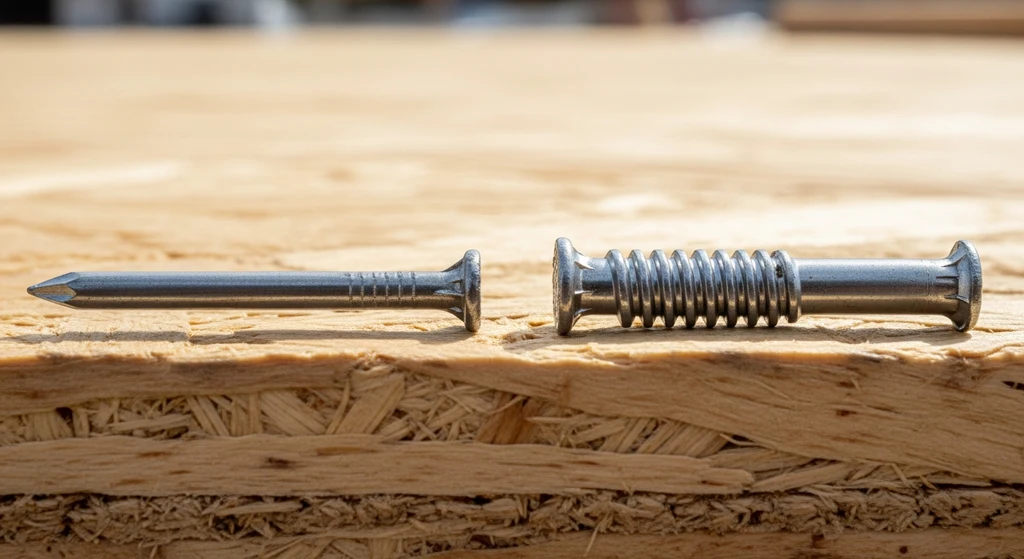
| Nail Type | Length | Shank Diameter | Best Use Case |
|---|---|---|---|
| 8d Common | 2.5″ | 0.131″ | Standard CDX Plywood |
| 8d Box | 2.5″ | 0.113″ | Thinner OSB Panels |
| 8d Ring-Shank | 2.5″ | 0.131″ | High-Wind/High-Heat Zones |
Critical Errors in Decking Fastening
The most frequent error I see in the DFW Metroplex is the over-driving of nails with pneumatic nailers. When a nail head punctures the top layer of CDX plywood or OSB, its holding power is reduced by over 50%. This creates a ‘perforation’ effect where the decking can easily pull over the nail heads during high winds. Another common issue is missing the rafter entirely, often called ‘shiners.’ While a few missed nails are common, a pattern of shiners means the deck is not structurally tied to the home’s frame.
OSHA safety standards also come into play here; a poorly secured deck is a major fall hazard for subsequent trades, including the shingle installers and gutter crews. Finally, many crews fail to leave the required 1/8-inch gap between panels. Without this space, the panels will buckle as they absorb moisture from the humid North Texas air. This buckling puts immense pressure on the nails, often shearing the heads off or pulling them through the rafters.
Proper spacing is a requirement of the APA – The Engineered Wood Association.
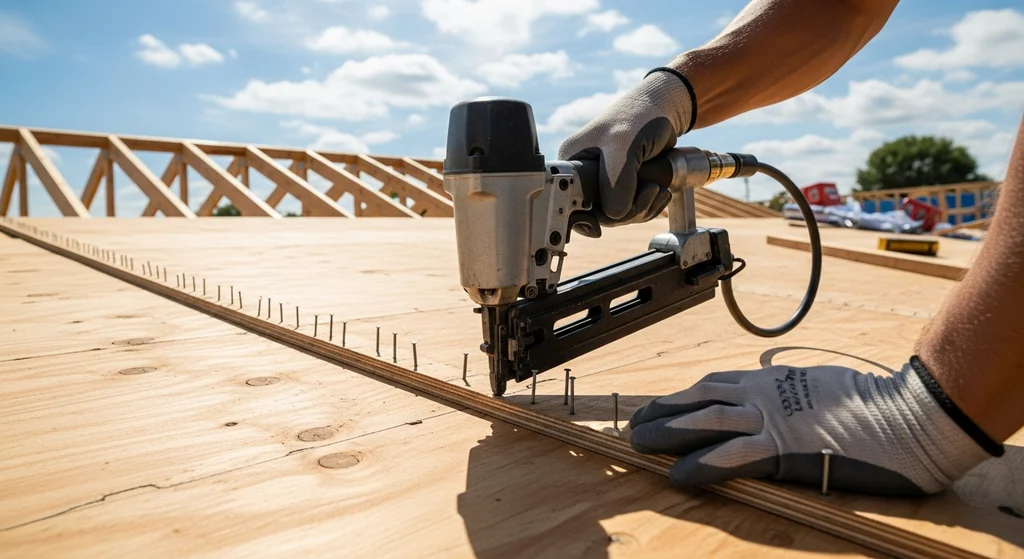
Nail heads buried deep in the wood
Consequence: Reduced wind uplift resistance and code failure.
Using staples instead of 8d nails
Consequence: Insurance claim denial and structural instability.
External Authoritative Resources
These industry-standard references support the information in this guide:
Building Codes
International Residential Code (IRC 2021)
Official building code for residential construction
ICC Code Adoption Map
Find which IRC version your state uses
Industry Standards
NRCA Roofing Manual
National Roofing Contractors Association best practices
ASTM International Standards
Material testing standards (ASTM D3043, D1761)
Manufacturer Resources
Frequently Asked Questions
Can I use 6d nails for roof decking?
No, IRC R803.2.1 generally requires 8d nails for standard 7/16-inch to 5/8-inch decking. Using 6d nails significantly reduces the shear strength and wind resistance of your roof system.
What is the difference between common and box nails?
Common nails have a thicker shank (0.131″) than box nails (0.113″). While both are allowed by code, the NRCA recommends common nails for better structural integrity in storm-prone areas.
How many nails are required per 4×8 sheet of plywood?
A standard 4×8 sheet requires approximately 33 nails when following the 6-inch edge and 12-inch field spacing pattern. This ensures the panel meets ICC structural standards.
Are staples allowed for roof decking in Dallas?
While some older codes allowed staples, most modern Dallas jurisdictions and the NRCA strongly discourage them in favor of 8d nails due to superior performance in high winds.
Should I use galvanized nails for roof decking?
Yes, ASTM A153 hot-dipped galvanized nails are preferred to prevent corrosion, especially if you are using pressure-treated wood or live in a high-humidity environment.
What happens if the contractor over-drives the nails?
Over-driven nails blow through the wood fibers, effectively ‘un-attaching’ the deck from the rafter. This is a major code violation under IRC R803.2.1 and must be corrected.
Final Thoughts
Getting the roof decking nail size right is a non-negotiable aspect of professional roofing in North Texas. By adhering to IRC 2021 standards and utilizing 8d ring-shank fasteners that meet ASTM D1761, you protect your home from the violent wind uplift and thermal stresses common in the DFW Metroplex. FIELD NOTE #3: I recently consulted on a project in Frisco where the contractor tried to use 1.5-inch roofing nails for the decking because ‘that’s all he had on the truck.’ We stopped the job immediately. A roof is only as strong as its connection to the house.
Always demand an inspection of the fastening pattern before the synthetic underlayment or ice and water shield is applied. This small check can save you tens of thousands of dollars in future repairs.
