
A stain shows up on the ceiling of a Cinco Ranch home. The homeowner points at it. The roofer climbs up, looks at the shingles right above that room, and finds nothing wrong. That scene plays out all over Katy, because the stain is the end of the water’s trip.
We are a roof repair crew in Katy, and leak calls are the biggest part of our week. The first lesson of every call is the same: the stain lies. This guide shows where leaks really start, how we trace them, and which checks you can safely do yourself.
Why the stain is not where the leak is
Rain gets in through a crack or a gap. Under the shingles sits the decking, sheets of plywood laid over the rafters. Water that slips past the shingles lands on that deck and follows it. It runs downhill along a rafter, creeps along the seam between two sheets, and drips off at the first nail hole or joint it meets. That drip can land several feet from the entry point, sometimes in the next room.
Insulation makes it worse. It soaks up water like a sponge and spreads it sideways before it ever shows on the ceiling. So the stain grows wide and soft at the edges, and by the time paint bubbles, the real hole may sit above attic that looks bone dry.
This is why sealing the shingles right above a stain fails so often. The patch lands on healthy roof while the true opening sits uphill, still open. Every failed repair we get called to fix starts with that same mistake.
The leak sources, ranked by how often we find them
When we trace leaks across Katy, from Nottingham Country to Kelliwood, the same seven sources come up again and again. Here they are in the order we find them.
1. Flashing around chimneys and walls
Flashing is the metal that seals the joints where the roof meets a chimney, a wall, or a vent stack. Nails back out of it. Sealant dries and splits in the Texas sun. The metal itself rusts at the bends. Once that seal opens, every hard rain pushes water behind the shingles, and it travels from there. Flashing causes more leaks than any other source on this list. Our full guide on roof flashing repair covers it.
2. Vent boots cracked by Texas heat
Every plumbing vent that pokes through your roof wears a rubber boot. Katy heat is brutal on rubber. Boots dry out, split, and pull away from the pipe after 10 to 15 summers, often long before the shingles around them wear out. Rain runs straight down the pipe and into the attic below. The good news: a cracked boot is one of the cheapest fixes on any roof.
3. Valleys
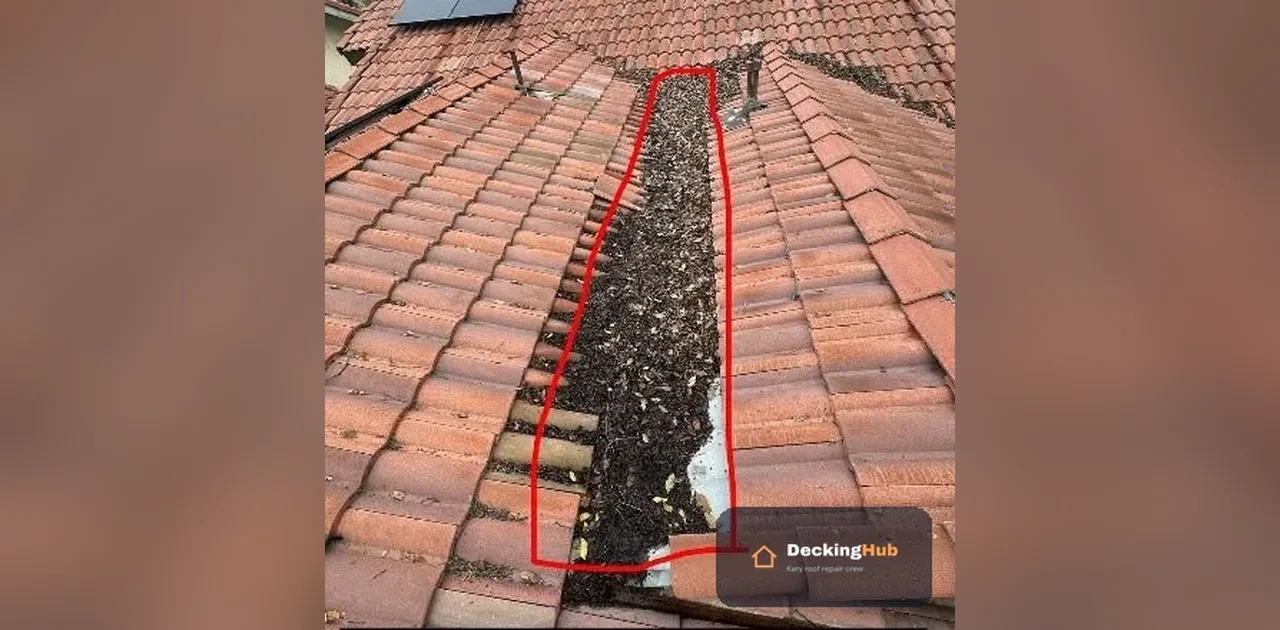
A valley is the channel where two roof slopes meet, and it carries more water than any other part of the roof in a storm. Leaves and grit pile up in it. The shingle edges along it crack and curl with age. One lifted edge in a valley can take in a lot of water in a single downpour, and the stain shows up far below where the water entered.
4. Skylight seals and flashing
A skylight is a framed hole in the roof, and it stays dry only while its seals and step flashing hold. Sealant dries out. The frame gasket shrinks. Water slips in at the top edge and runs down inside the shaft, so the stain often appears below the skylight and gets blamed on the roof field around it. If your stain sits under or near a skylight, start the search there. Our guide to skylight leak repair in Katy walks through the causes.
5. Ridge cap and exposed nails
The ridge is the peak line of the roof. Cap shingles crack as they age, and storm wind can lift them. Nail heads that work loose or were left exposed rust through and let water in a drop at a time. Ridge leaks are slow. The stain grows for months before anyone thinks to look up.
6. Gutters backing up at the eaves
Full gutters do more than spill over the front. Water that cannot drain backs up under the first row of shingles at the eave, rots the edge of the decking, and works its way into the wall. If your stain sits on an outside wall, check the gutter line above it before you blame the roof. A clogged gutter needs no roofer at all, just a ladder and a scoop on a dry day.
7. Storm lifted shingles
Katy sits in a hail corridor, and spring storms do two things at once: hail bruises the shingles while wind lifts their edges. A lifted shingle can settle back down and look fine from the ground even though its seal strip is broken. The next driving rain pushes water right under it. Any new stain after a big storm deserves a close look, even when the roof looks whole.
How a pro traces a leak
Guessing costs you money twice: once for the wrong repair, and again for the right one. A real trace follows a set order.
Start in the attic. With a good light, we look for daylight around vents and chimneys, dark water trails on the decking, damp insulation, and rusted nail tips. We follow the trail uphill to the highest wet point, and the entry is almost always at or just above it.
Check the moisture. Decking and drywall can hold water long after the surface looks dry. Simple moisture checks on the wood tell us how far the water spread and whether the deck is still sound under dry looking shingles. That decides whether a small repair will hold or the wood has to come out.
Run a hose test. If the attic gives no clear answer, two people settle it. One runs a hose on the roof in small sections, starting low and working up, soaking one area at a time. The other waits in the attic and watches. The section that drips names the source. Slow work, but it ends the argument.
Photograph everything. Every step gets a photo, from the stain to the entry point, so you see the same water path we saw.
Call (281) 677-8586
Checks you can do yourself, safely
From the ground, with binoculars. Look for lifted or missing shingles, cracked cap shingles along the ridge, debris sitting in the valleys, and gutters that sag or overflow in rain. Note which slope sits above the stain, then look uphill from there, not straight down.
From the attic, after rain. Take a flashlight and look for wet decking, dark trails, and daylight around vents and the chimney. The wettest, highest point you can find is your best clue. A dry attic right after a storm, with a stain that grows anyway, points at plumbing or AC drains instead of the roof.
Watch the pattern. A stain that grows only in hard, wind driven rain points at flashing or a valley, places water reaches only when it blows sideways. A stain that grows in every gentle rain points at an open gap, like a split vent boot. When the stain grows tells you as much as where it grows.
One hard rule. Never walk a wet roof. Wet shingles are slick, and a rotted spot can give way under your weight. Ground checks and attic checks only. The roof itself is our job, with the right gear.
When the search stops being DIY
Call us when any of these show up: a stain that comes back after a repair, stains in more than one room, a musty smell in the attic or a closet, or decking that feels soft from the attic side. Water near light fixtures or ceiling fans is a safety problem, not a roofing problem first. Kill the power to that room and call.
If water is actively coming in right now, read our guide on what to do in a roof leak emergency before anything else. It covers the first hour, step by step.
And once the source is found, the fix is usually smaller than homeowners fear. Most leak repairs run $300 to $1,200. Our breakdown of roof leak repair costs in Texas shows exactly where that money goes, so there are no surprises.
Leak detection questions
How do I find out where my roof is leaking from?
Start in the attic with a flashlight after rain. Find the wet trail on the decking and follow it uphill to the highest wet point. The entry sits at or just above that point, usually at flashing, a vent boot, or a valley. If the attic shows no clear trail, a hose test, one roof section at a time, will find it.
Can you have a roof leak and not know it?
Yes, and it is common. A slow leak can soak insulation and decking for months before a stain shows. The early signs are a musty smell in a closet or attic, paint that bubbles in one spot, or a small stain that grows a little with each storm and then dries. By the time the stain is obvious, the water has usually been coming in for a while.
What is the average cost of leak detection?
With DeckingHub, finding the leak costs nothing. The trace is part of our free roof inspection, photos included. You pay only for the repair after the source is found, and most leak repairs run $300 to $1,200 depending on which part failed.
Why is the ceiling stain not under the leak?
Because water travels before it drops. It gets in at a weak point, runs along the decking and down a rafter, and falls at the first seam or nail hole it meets. That spot can be feet away from the entry, sometimes in another room. Patching the roof above the stain patches the wrong place.
Can I find a roof leak myself?
You can narrow it down. Ground checks with binoculars and attic checks after rain will often point at the right area, and the pattern of when the stain grows is a real clue. What you should not do is walk the roof, above all when it is wet. Sealing the exact source takes a roof level look, in dry weather.
How long can a small leak wait?
It should not wait at all. Every rain adds water to wood that is already wet, and decking rot spreads quietly. A leak repair today runs $300 to $1,200. Left for a year, the same leak adds decking replacement on top. Small leaks are cheap. Old leaks are not.
Leak hunting rewards patience over guesswork. Find the true source once, fix that one spot right, and the stain dries for good. If we trace a leak and the fix is small, we will tell you it is small. That honesty is the whole point of Katy roof repair done right the first time.
Call (281) 677-8586
Lines open 7 AM to 9 PM.