
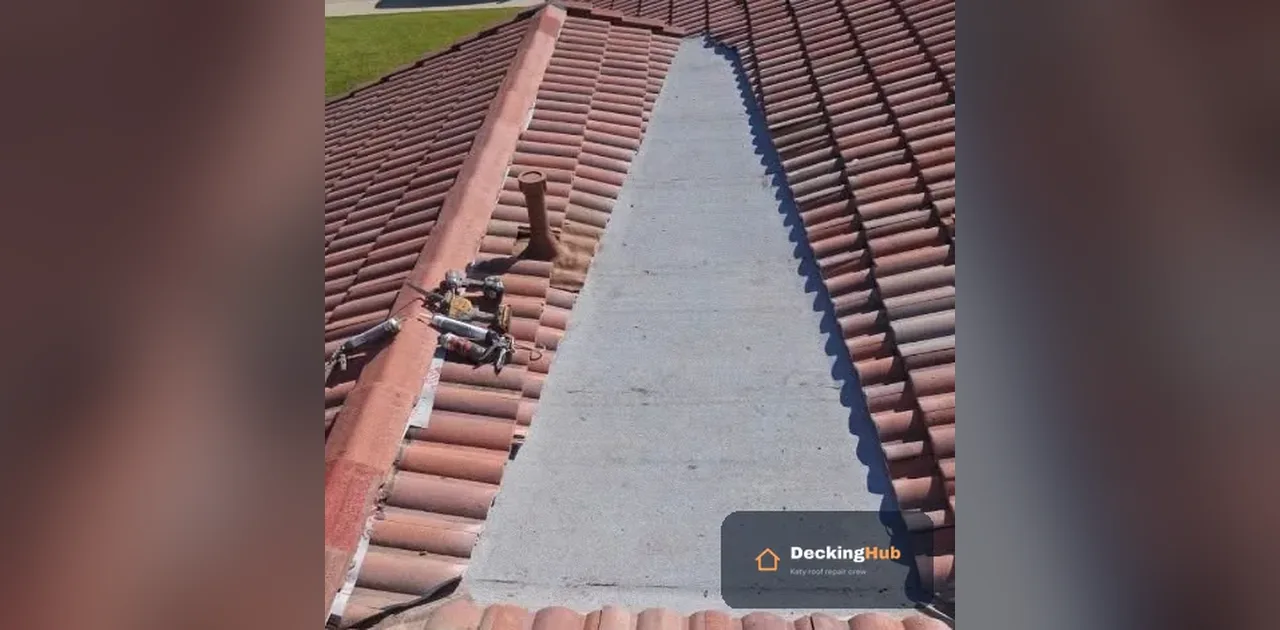
A brown stain shows up on the ceiling below the chimney. The homeowner calls about shingles. Most of the time, the shingles are fine. The metal around the chimney is the problem.
Flashing is the most overlooked part of a roof. Nobody brags about it and it adds nothing to how the house looks. But every joint, corner, and hole in your roof depends on a piece of bent metal to stay dry. When that metal fails, water gets in, even on a roof that looks perfect from the street.
We are a roof repair crew in Katy, and flashing calls make up a big share of our week. This guide covers what flashing is, where it hides, how to spot it failing, why a tube of caulk does not fix it, and what a real repair costs in 2026.
What flashing is and where it hides
Flashing is thin metal, usually aluminum or galvanized steel, cut and bent to fit each joint on the roof. Shingles shed water down a slope. Flashing handles the spots where the slope stops, turns, or gets interrupted. Here is where it lives on a typical Katy home.
Chimney flashing
Two parts work together. Base flashing wraps the bottom and sides of the chimney, and counter flashing folds over the top edge and tucks into the mortar. This spot takes the most water abuse of any flashing on the roof, and it fails the most.
Step flashing
Where a roof slope meets a wall, small metal pieces step up the wall, one piece for each row of shingles. Each piece overlaps the next, so water always lands on metal and runs down and out.
Valley metal
Two slopes meet in a valley, and that valley carries a river of water in a hard Katy rain. A metal liner under the shingles takes that flow. If it rusts through or splits, the leak can be large.
Vent flashing
Every plumbing vent and exhaust pipe that pokes through the roof gets a metal collar, often with a rubber boot on top. The rubber cracks in Texas heat long before the metal does, and a cracked boot is one of the most common leaks we find.
Skylight flashing
Skylights sit in a frame that needs flashing on all four sides. A leak at a skylight is almost always the flashing kit or its seals, not the glass. We walk through that fix in our skylight leak repair guide.
Drip edge
This is a metal strip along the eaves and the sloped edges of the roof. It guides water off the edge and into the gutters. It also keeps water from curling back under the shingles and rotting the edge of the deck.
Signs your flashing is failing
Flashing rarely fails all at once. It gives warnings first, and most of them are easy to spot in a photo or with a pair of binoculars from the ground.
Rust lines. Rust streaks running down from a chimney or vent mean the metal is breaking down. Surface rust turns into a hole, and a hole in flashing is a leak waiting for the next storm.
Lifted or bent edges. Wind and years of heat cycles can pry flashing edges up. A lifted edge is an open door for rain that blows sideways.
Cracked or peeling sealant. If you see cracked tar or peeling caulk along a joint, someone tried the cheap fix before you. It has already failed once.
Stains below a joint. A stain on a wall or ceiling right below a chimney, a wall joint, or a valley is a flashing leak until proven otherwise. Our leak detection guide shows how we trace a stain back to the spot where water gets in.
Leaks only in hard rain. If the roof stays dry in a normal rain but leaks when rain blows sideways, suspect flashing. The open field of the roof sheds straight rain fine. Lifted joints let driven rain slip in.
Why the caulk fix fails
The most common repair we undo is a fat bead of sealant smeared over dead flashing. It looks like a fix. It is not one.
First, sealant cannot heal the metal under it. If the flashing is rusted, cracked, or pulled loose, the hole is still there. The caulk just hides it. Worse, a heavy smear can trap water that sneaks in behind it, and trapped water rots the decking faster than a plain leak would.
Second, Katy heat cooks sealant. A roof surface here can top 150 degrees in July. Caulk bakes, shrinks, and cracks, often within one or two summers. Then the leak comes back, usually worse, because the deck has soaked up two more years of water.
Sealant does have a place in roofing. It seals nail heads and small joints on healthy metal. It is a finishing tool, not a repair for failed flashing. If a quote for a flashing leak is just a tube of caulk, you are buying months, not years.
What proper flashing repair looks like
A real flashing repair is metal work, not glue work. Here is the job, step by step.
The old metal comes out. The failed flashing comes off, along with the shingles around the joint. You cannot weave new metal into a joint you cannot see.
We check what sits under it. Water that got past the flashing often marks the decking and the underlayment below. Soft or rotted wood gets cut out and replaced. New flashing over rotten decking is a waste of good metal.
New metal goes in woven with the shingles. Fresh flashing is set in with the shingle rows, each piece overlapping the one below it, so water sheds over the joint and never under it. Nails sit where the next row of shingles covers them.
The chimney gets done the right way. On a chimney, the counter flashing is cut into the mortar joint and sealed there. Gluing a strip flat to the face of the brick is the shortcut that fails. Metal cut into the joint stays put for the life of the roof.
Call (281) 677-8586
Flashing repair costs
These are 2026 Katy and Houston area ranges, parts and labor included. The spread is wide because one valley can be a short job, while a chimney reflash is a full project.
| Repair | Typical cost |
|---|---|
| Flashing repair, general | $150 to $1,500 |
| Chimney flashing repair | $350 to $700 |
| Full chimney reflash | $1,200 to $1,500 |
| Valley repair | $300 to $1,500 |
Where your job lands turns on access, how much metal has to come out, and what the deck looks like under it. For the full picture of what leaks cost to fix, see our roof leak repair cost guide.
Flashing and your tune up
Flashing failure is slow, and that is good news. It means a regular check catches it while the fix is still small.
On a roof tune up, we walk every joint on the roof. We check flashing edges, reseal the spots that need it, look at the vent boots, and clear the valleys. A tune up starts at $199, and it is the cheapest flashing protection you can buy. Finding a lifted edge in April beats finding a ceiling stain in September.
In Cinco Ranch, Elyson, and across Katy, we see the same pattern. The homes that leak are not always the oldest ones. They are the ones nobody looked at for ten years.
Roof flashing questions
How much does it cost to repair flashing on a roof?
Most flashing repairs in the Katy area run $150 to $1,500. A small spot repair on healthy metal sits at the low end. Chimney work costs more: $350 to $700 for a repair, and $1,200 to $1,500 for a full reflash with new metal cut into the mortar.
Can roof flashing be repaired?
Yes, if the metal is sound and the trouble is a lifted edge or a failed seal, a repair holds well. If the metal is rusted through, cracked, or was installed wrong in the first place, patching it is wasted money. That spot needs new flashing.
How often does roof flashing need to be replaced?
Good flashing can last as long as the roof around it, 20 years or more. The seals and rubber parts fail sooner. Vent boots often crack after 10 to 15 years of Texas sun. A check every few years catches the cheap failures before they turn into leaks.
Will homeowners insurance cover a roof repair?
Insurance covers sudden damage, like flashing torn loose by a storm or a limb through the roof. It does not cover rust, age, or wear. If your flashing failed because it is old, the repair is on you. If a storm bent or tore it, take dated photos and call your insurer.
Can flashing be replaced without replacing the roof?
Yes. Roofers swap flashing sections on healthy roofs all the time. The shingles around the joint come up, new metal goes in, and the shingles go back down. You only need a new roof when the shingles themselves are done.
What happens if bad flashing is left alone?
Water keeps getting in at the joint. It rots the decking, soaks the insulation, and stains ceilings and walls. A $300 flashing repair left alone for two years can grow into decking work, drywall work, and a much bigger bill.
Call (281) 677-8586
Lines open 7 AM to 9 PM.
Not sure if the flashing is your problem? That is what the free check is for. We are a Katy roof repair crew, and we would rather reseal a joint today than rebuild a rotted corner next year.