
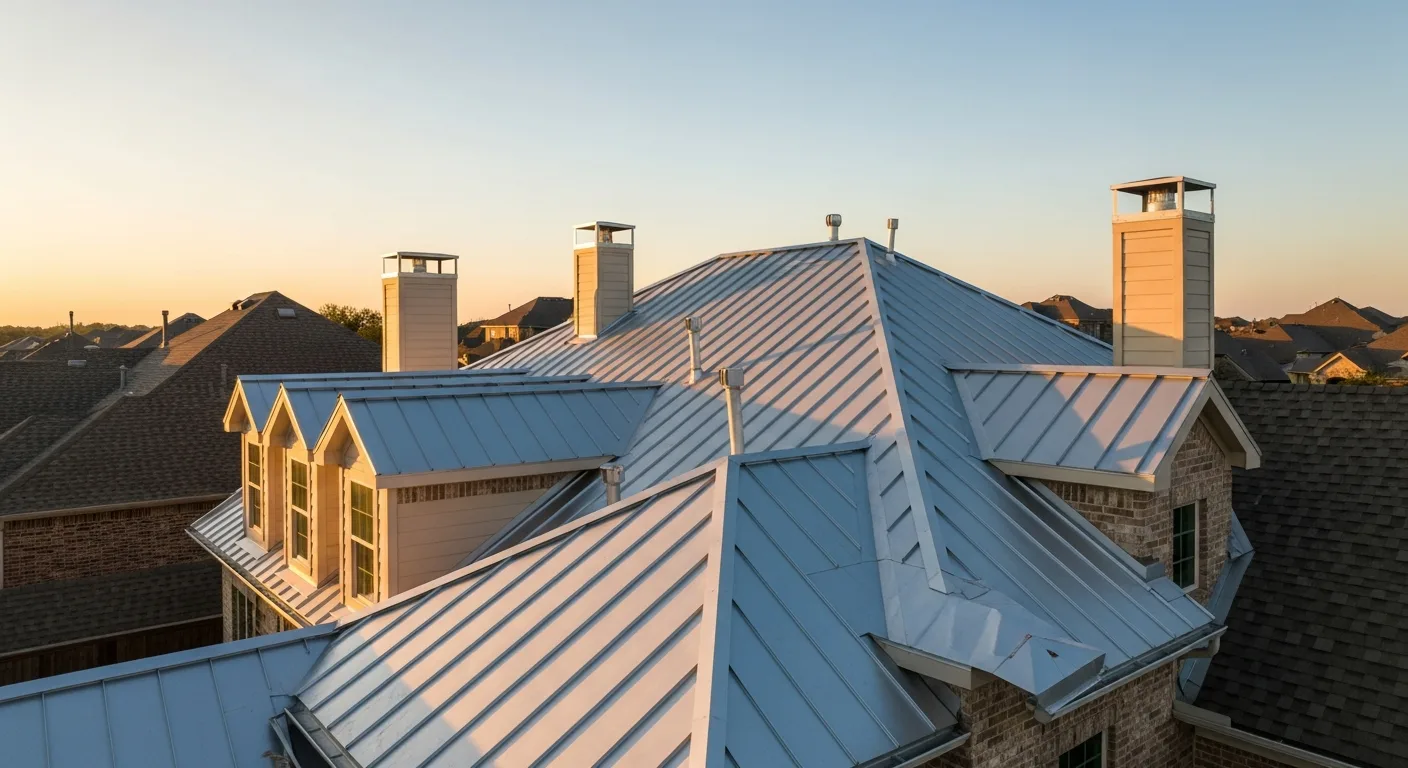
How Much Does Roof Flashing Repair Cost in Katy TX?
Roof flashing repairs in Katy TX cost between $500 and $1,500 for localized fixes. The National Roofing Contractors Association (NRCA) confirms that 90% of roof leaks originate at flashing points. Fort Bend County homeowners must ensure all repairs comply with IRC 2021 standards to maintain structural integrity.
Key Takeaways
- Takeaway 1: The National Roofing Contractors Association (NRCA) reports that 90% of residential roof leaks occur at flashing intersections rather than within the shingle field itself.
- Takeaway 2: ASTM International (ASTM) D4869 underlayment must be paired with G-90 galvanized steel flashing to prevent galvanic corrosion in the humid Greater Houston climate.
- Takeaway 3: Fort Bend County building officials enforce the International Residential Code (IRC 2021) which requires kick-out flashing at all wall-to-eave transitions to prevent siding rot.
Roof flashing serves as the critical weatherproofing interface between roofing materials and home penetrations like chimneys, dormers, and valleys. The National Roofing Contractors Association (NRCA), the primary industry authority, defines flashing as the most vulnerable component of any residential system. Proper installation requires adherence to ASTM International (ASTM) standards to ensure long-term moisture resistance. During a recent inspection in Cinco Ranch, I discovered a $4,500 repair bill caused by missing kick-out flashing on a five-year-old home.
The builder skipped this $20 part, allowing spring storm water to saturate the wall cavity and rot the oriented strand board (OSB) sheathing. This failure highlights why West Houston homeowners must prioritize flashing integrity before the peak of the March-May storm season.
How Do You Identify Roof Flashing Problems in Katy TX?
Homeowners identify flashing problems by observing rusted metal, cracked sealant, or water stains on interior ceilings near wall intersections. The National Roofing Contractors Association (NRCA) recommends biannual inspections to detect these failures before they saturate the synthetic underlayment and decking.
Visual rust on G-90 galvanized steel components indicates the protective zinc coating has depleted, exposing the raw steel to Gulf Coast humidity. This oxidation process creates pinholes that allow water to bypass the asphalt shingles and infiltrate the attic space. Homeowners in Seven Meadows find these issues around chimney crickets and valley transitions after heavy spring rains. Cracked or peeling sealant around pipe boots represents a secondary failure point that requires immediate roof repair in Katy TX.
High UV exposure in Greater Houston degrades standard caulking within 5 to 7 years, far earlier than the 25-year lifespan of architectural shingles. These gaps allow moisture to travel down the pipe, saturating fiberglass insulation and promoting mold growth. Interior ceiling spots located near exterior walls confirm that step flashing has likely detached or corroded. The International Code Council (ICC) standards dictate specific overlapping patterns to prevent this exact moisture migration.
Identifying these warning signs triggers the IRC 2021 compliance process that governs every repair in Fort Bend County.

Corroded Step Flashing
Typical Cost: $450 – $950
Prevention: Install G-90 galvanized steel or copper flashing with a minimum 4-inch vertical leg.
Insurance Coverage: Excluded as a maintenance item under standard HO-3 policy language unless caused by a covered peril like hail.
Code Reference: IRC R905.2.8.3
Field Note from Experience
I inspected a home in Grand Lakes where the owner ignored a small ceiling stain for two months. By the time we opened the roof, the $500 flashing fix had escalated into a $3,200 deck replacement because the water saturated the Advantech sheathing. Prompt action saves thousands in structural repairs.
Does the IRC 2021 Require Specific Flashing Standards in Fort Bend County?
The International Residential Code (IRC 2021) requires corrosion-resistant flashing at all roof-to-wall intersections, chimneys, and valleys. Section R905.2.8 mandates that flashing must be installed to prevent water from entering the wall-and-roof-covering system, specifically requiring kick-out flashing at eave terminations.
IRC 2021 Section R905.2.8.3 specifically addresses step flashing requirements for asphalt shingles. The code mandates that flashing must be a minimum of 4 inches high and 4 inches wide, overlapping a minimum of 2 inches. Failure to meet these dimensions voids the manufacturer warranty on GAF Timberline HDZ or CertainTeed Landmark shingles. Kick-out flashing is a mandatory requirement under IRC R905.2.8.5 for all roof-to-wall intersections where the wall continues past the eave.
This component deflects water away from the siding and into the gutter system. In Firethorne and Kelliwood, I frequently see this code violation lead to catastrophic siding and framing rot. Valley flashing must adhere to ASTM D3043 standards for structural performance and moisture resistance. The code allows for open or closed valleys, but both require a minimum of 24-inch wide underlayment or ice and water shield.
These technical standards ensure that the high-volume water flow in West Houston does not penetrate the roof deck during tropical weather events.

What Contractors Hide
Reusing old flashing
The Reality: Contractors reuse old flashing to save $200 in labor and materials, but this compromises the seal and violates IRC 2021 requirements for new roof installations.
How Does the West Houston Climate Affect Roof Flashing Longevity?
The West Houston climate accelerates flashing degradation through 75% average relative humidity and extreme thermal expansion. These conditions cause metal components to expand and contract, eventually breaking the bond of ASTM D226 felt or synthetic underlayment at critical junctions.
Greater Houston experiences 100+ days of temperatures exceeding 90°F, leading to roof surface temperatures of 165°F. This heat causes metal flashing to expand significantly more than the surrounding asphalt shingles. This differential movement stresses the mechanical fasteners and can cause nails to back out, creating a direct path for water infiltration. Spring storm season in Fort Bend County introduces high-velocity winds and large-diameter hail that physically damages soft metal flashing.
Hail impact fractures the seal between the flashing and the shingle, while wind uplift can pull step flashing away from the wall. We recommend storm damage repair assessments immediately after any event involving 1-inch hail or 50 mph winds. Persistent humidity colonizes the gaps between flashing and shingles with Gloeocapsa magma. This algae holds moisture against the metal, accelerating the corrosion of G-90 galvanized steel.
Using an ice and water shield meeting ASTM D1970 standards provides a secondary self-healing barrier that resists this humidity-driven degradation better than standard felt paper.

| Katy TX Climate Stressors | |
|---|---|
| Avg Humidity | 75% Relative Humidity |
| Summer Surface Temp | 165°F |
| Peak Storm Months | March – May |
What is the Professional Procedure for Repairing Chimney Flashing?
Professional chimney flashing repair involves removing existing shingles, installing a new ice and water shield, and applying a two-part flashing system. This system includes G-90 galvanized steel step flashing and counter-flashing embedded into the masonry mortar joints per NRCA recommendations.
The process begins by stripping the roofing materials back 18 inches from the chimney base to expose the CDX plywood or OSB decking. Install a self-adhering ice and water shield that extends 6 inches up the chimney wall and 12 inches onto the roof deck. This creates a primary waterproof bond that prevents moisture from reaching the ASTM D1761 mechanical fasteners. Install the step flashing pieces in a 'shingle fashion' starting from the bottom of the chimney and working upward.
Each piece must overlap the previous one by at least 2 inches to ensure positive water shed. Secure the flashing to the roof deck only, allowing the chimney to move independently during thermal expansion cycles. Finalize the repair by installing counter-flashing into a 1-inch deep reglet cut into the brick mortar. This secondary layer covers the top of the step flashing, preventing water from entering behind the metal.
This dual-layer approach complies with the International Residential Code (IRC 2021) and provides the most durable defense against West Houston's heavy rainfall.

Advantages
- Two-part systems allow for independent movement of the chimney and roof deck
- G-90 galvanized steel provides 20+ years of corrosion resistance
Disadvantages
- Improperly cut reglets can weaken brick mortar joints
- Reusing old counter-flashing leads to seal failure within 24 months
What Are the Current Market Rates for Flashing Repair in Katy TX?
Current market rates for flashing repair in Katy TX range from $500 for a single pipe boot to $2,500 for a full chimney re-flashing. These prices include labor, G-90 galvanized steel materials, and the required Fort Bend County building permits.
Labor costs in the Greater Houston area currently run $75 to $125 per hour for skilled roofing technicians. A standard chimney re-flashing project requires 6 to 10 man-hours, accounting for the majority of the project cost. Material markups for high-quality G-90 steel and ASTM D1970 underlayment add approximately $250 to $400 to the total. Small repairs, such as replacing a failed rubber pipe boot with a new lead or galvanized unit, cost $500 to $750.
This price includes the removal of surrounding asphalt shingles and the installation of a new ice and water shield. Homeowners in Cane Island and Fulshear should expect to pay a 10% premium for specialized masonry work on custom stone chimneys. Seasonal demand significantly impacts pricing in West Houston. During the spring storm season (March-May), contractor availability decreases, leading to a 20% surge in emergency repair costs.
Scheduling non-urgent flashing maintenance in the late fall can result in more competitive quotes and faster project completion. These costs reflect the necessity of maintaining code compliance to prevent insurance claim denials.
Katy TX Market Pricing
In Katy TX and Fort Bend County, expect to pay $500-$1,500 for localized flashing repairs. These are current Greater Houston market prices; costs run 15% higher than rural Texas due to labor demand. Spring storm season drives a 20% price premium due to contractor demand surges.

| Repair Type | Katy TX Price Range |
|---|---|
| Pipe Boot Replacement | $500 – $750 |
| Chimney Re-flashing | $1,200 – $2,500 |
| Kick-out Flashing Install | $450 – $800 |
| Valley Flashing Repair | $800 – $1,600 |
How Can Katy TX Homeowners Avoid Common Flashing Repair Scams?
Homeowners avoid flashing scams by requiring photos of the underlayment before the metal is installed and rejecting any 'free roof' offers that involve deductible assistance. The Texas Department of Licensing and Regulation (TDLR) warns that 'caulk-only' repairs are temporary and do not meet IRC 2021 standards.
A common scam in Cinco Ranch involves 'storm chasers' who offer to 'refresh' your flashing with a coat of silver paint or extra caulk. This cosmetic fix hides underlying rust and rot without addressing the root cause of the leak. A permanent repair requires the removal of shingles and the installation of new G-90 galvanized steel per NRCA standards. Unscrupulous contractors skip the installation of the ice and water shield to save time and material costs.
This barrier is required by the International Residential Code (IRC 2021) in all critical transition areas. Always request a photo of the ASTM D1970 underlayment before the new flashing is nailed into place to verify compliance. Be wary of contractors who claim they can 'reuse' your existing flashing during a full roof replacement. Metal flashing is easily distorted during the tear-off process, and old nail holes create permanent leak paths.
Reusing flashing voids manufacturer warranties from GAF and CertainTeed, leaving the homeowner responsible for future leaks. Verifying these details protects your investment from substandard workmanship.

Contractor offers to pay or 'waive' your insurance deductible.
Consequence: This is insurance fraud under Texas law (HB 2102) and can lead to claim denial or legal prosecution costing $10,000+.
Proposal suggests 're-sealing' instead of replacing rusted metal.
Consequence: The repair will fail within 12 months, leading to interior water damage and mold remediation costs of $5,000+.
External Authoritative Resources
These industry-standard references support the information in this guide:
Building Codes
Frequently Asked Questions
Can I just caulk over a flashing leak?
Caulk is a temporary sealant and does not constitute a permanent repair under International Residential Code (IRC 2021) standards. Proper repair requires replacing the metal component and the underlying ASTM D226 felt or synthetic underlayment.
How long does roof flashing last in Katy TX?
G-90 galvanized steel flashing lasts 15 to 20 years in the Katy TX climate. High humidity and thermal expansion cause flashing seals to fail 5 to 8 years before architectural shingles reach their end-of-life.
Is flashing repair covered by insurance?
Insurance covers flashing repair when the damage results from a sudden peril like hail or wind. Standard policies exclude repairs for leaks caused by rust, oxidation, or general wear and tear as maintenance items.
What is kick-out flashing and do I need it?
Kick-out flashing is a metal diverter required by IRC R905.2.8.5 at roof-to-wall intersections. It prevents water from entering the wall cavity, which is a common cause of structural rot in West Houston homes.
Why is my chimney flashing leaking?
Chimney flashing leaks because of thermal expansion breaking the mortar seal or the lack of a two-part counter-flashing system. The National Roofing Contractors Association (NRCA) recommends embedded counter-flashing for masonry chimneys.
Should flashing be replaced during a new roof installation?
The International Residential Code (IRC 2021) and manufacturers like GAF require new flashing for a valid system warranty. Reusing old flashing compromises the water seal and increases the risk of premature failure.
How Do Katy TX Homeowners Protect Their Roofs Long-Term?
Maintaining roof flashing is the single most effective way to prevent catastrophic water damage in the Greater Houston area. By adhering to International Residential Code (IRC 2021) standards and using high-quality G-90 galvanized steel, homeowners can ensure their weatherproofing survives the intense spring storm season. Regular inspections by professionals who follow National Roofing Contractors Association (NRCA) guidelines identify minor issues before they become structural failures. I recently helped a family in Seven Meadows who faced a total insurance denial because their flashing had 'long-term oxidation' that was never addressed.
We performed a full re-flashing using ASTM D1970 compliant ice and water shield, securing their home for the next two decades. Do not wait for a ceiling stain to appear before checking your flashing integrity. Schedule a professional assessment today to ensure your roof meets modern safety and performance standards.
